Foundation Water Leak or Slab Leak, Settled in One Evening
The short version
- Weather is the first filter. Damp that arrives with a storm and fades through a settled week is groundwater; damp that holds through a dry week is a line under pressure.
- The meter is the arbiter. EPA has the register compared against itself two silent hours apart, and the smallest difference counted as a leak.
- A crack is an exit, not a cause. The Arizona Geological Survey lists foundation cracks and ruptured pipelines side by side as damage from problem soils.
- The wall penetration is an opening by design: IPC 305.3 calls for a relieving arch or a sleeve two pipe sizes greater than the pipe passing through.
- Finding out is cheap. HomeAdvisor puts slab leak detection at $150 to $400, and HomeGuide puts a whole slab foundation inspection at $300 to $750.
Usually a foundation water leak that shows up only after rain is groundwater, and one that runs in dry weather while the meter creeps is a pressurized line under the slab. Three tests separate them and the first two are free: weather, then the dial, then the wet edge.
A water leak in the foundation of a house covers seepage outside, which is drainage work, a broken line under concrete, which is plumbing, and the pipe failing at the wall between them.
| Evidence | Points outside | Points under the slab |
|---|---|---|
| Timing | Comes with a storm, fades in a dry week | Ignores the forecast |
| The meter | Dead still, every fixture closed | Low flow indicator keeps creeping |
| Who fixes it | Drainage contractor | Plumber on slab lines |
Test 1: does the damp follow the weather, or ignore it?
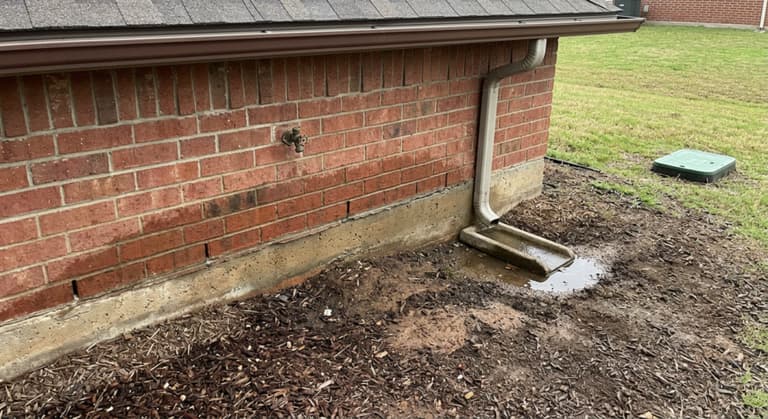
Rain is the cleanest filter. Seepage turns up during a storm or a day behind it and dries through a settled week. A pressurized line has no idea it is raining.
Clay ground makes the outdoor version convincing. The vertic features note in the NRCS series description of Houston Black, the Texas Blackland clay, records cracks from half an inch up to four inches across and a foot or deeper once the ground dries, staying open through 90 to 150 cumulative days in a typical year. Ground moving on that scale is why one look at a wet wall proves nothing.
Log the date, the rain and the damp edge; two storms and a settled week decide it.
Test 2: the meter, and the two hours that decide it
EPA's instruction runs one line: photograph what the register shows, let two silent hours go by with no tap or appliance drawing, compare the pictures, and treat the smallest difference as a leak. Any difference.
Find the leak detection dial first. Portland Water Bureau says it turns up as a small triangle on some registers and as a blue snowflake on others, and warns a drip barely moves it. Shut the irrigation controller and the ice maker, and check no toilet is running.
A dial that creeps through a dry week is plumbing. Dial (800) 555-0142 and say what it did: the call costs nothing, a licensed plumber on slab lines answers, and the five step hunt is how to find a leak under a slab.
Test 3: where the wet edge sits, and what a camera misses
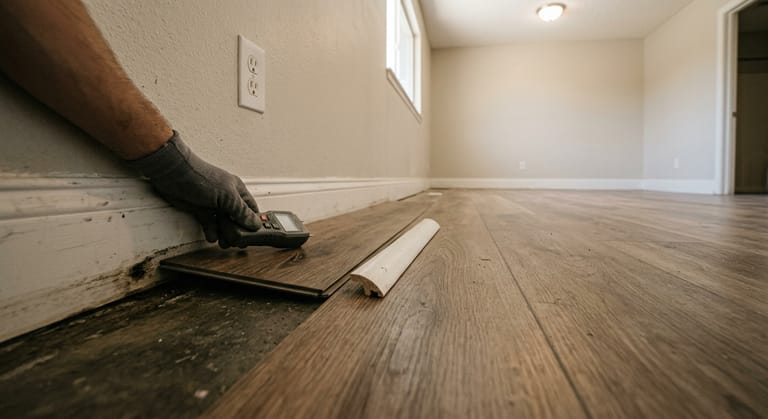
Seepage stays near the edge: along an exterior wall, worst at the lowest corner, drying inward. A line failing below surfaces wherever the slab lets it through: a grout seam, a toe kick, mid room, a patch that feels warm underfoot. Damp at a shared garage wall is its own case: wet concrete in the garage.
A cracked foundation, and where the water leak actually is
A crack is an exit, not a diagnosis. Among the damage the Arizona Geological Survey attributes to problem soils are foundation cracks, heaving and cracking of floor slabs and walls, jammed doors and windows, and ruptured pipelines. One ground condition, several results.
NRCS grades how far ground swells and shrinks on a linear extensibility scale topping out above 9 percent, and is equally plain about the limit: a survey interpretation is no substitute for construction-grade information. A county rating describes a neighborhood, never your house.
Sealing a foundation crack before testing moves the water leak to the next opening. Dial creeping? A plumber takes the call on (800) 555-0142, free. Holding still? Sealing and drainage are the honest fix.
How does water leak through foundation walls, and where code leaves an opening
The phrase covers two different failures. Seepage is one: damp pushing through concrete, joints and cold pours. The second is the penetration where the service line crosses the wall, an opening built in on purpose, since IPC 305.3 and IRC P2603.4 both call for a relieving arch or a sleeve two pipe sizes greater than the pipe.
IPC 305.1 adds that copper is kept clear of bare concrete, that whatever sleeves it is plastic and no thinner than 8 mil, and that where the pipe crosses concrete the sleeve leaves it room to shift. Nothing there expects a locked pipe, which is why a foundation leak around the water main reads on timing: damp in a dry week with a creeping dial is the service line, damp only in storms is the ground.
Water leak between the foundation and the sill plate
That seam is where the wood starts: a bottom plate bolted at the slab edge, or a sill plate on the foundation wall over a basement. It is the highest line outside moisture climbs to and the lowest indoor moisture runs to, so both arrive looking identical.
The same three tests settle that seam, and a water leak where brick meets the foundation too, a joint on the outside face. Photograph the wet edge, then stop: pressure isolation and acoustic work are not homeowner tools. Dial (800) 555-0142, free to ask.
Can a water leak cause foundation problems, or the reverse?
The documented direction runs from the soil. US patent 11,480,267 B2, granted for shielding utilities beneath a slab, opens its background section this way: "A significant amount of water damage often occurs when pressurized water lines break due to expansive soil damage". A patent background is the applicant's own account, examined for patentability rather than accuracy, so read it as evidence the failure mode is recognized. HUD's Cityscape describes the sequence above ground: walls move, cracks appear, doors start to jam, floors tilt.
The reverse, a leak wrecking a sound foundation, is asserted everywhere and quantified in none of the sources behind this page. Stop a confirmed loss quickly anyway, and leave the foundation verdict to a structural engineer in the house.
Foundation water leak repair: which trade first, and what finding out costs
- Read the meter. Two hours, every fixture closed, exactly as EPA writes it. Free.
- Dial creeping? Call a plumber on slab lines. HomeAdvisor, updated June 2026, puts slab leak detection at $150 to $400 and says to plan on $280.
- Dial still? The job is drainage. HomeGuide, bylined October 2025, prices a whole slab foundation inspection at $300 to $750.
A basement foundation water leak follows the same order, with the piping usually in sight. Census counted 160,000 houses finished in 2025 with a full or partial basement, against 754,000 filed under slab or other types.
Stillness for two hours and a settled week of weather decide this between them. Register still creeping? (800) 555-0142 reaches somebody who traces losses under concrete: no charge, nothing booked by telephone. Register frozen? Read the seven signs ranked by what each proves before paying anyone to dig.
Put it to someone who opens floors for a living
Call (800) 555-0142Costs nothing to dial. A licensed plumber who does slab work answers, not a scripted call center.Licensed partners who locate and repair slab leaks- Plumbers who locate the leak before anyone breaks concrete
- Someone picks up at 3 a.m. too
- No charge to call, no obligation to book
- Your quote comes from the plumber, with nothing added by us