What Is a Slab Leak, and What Causes One
The short version
- A slab leak is a plumbing failure, not a foundation failure. A cracked wall and a wet spot after rain are different problems with a different trade attached.
- NRCS rates soil movement as linear extensibility and puts damage to buildings above 3 percent, while saying that rating never replaces a site geotechnical report.
- The Copper Development Association's six causes of corrosion trouble, printed in full below, are mostly not about water. Flux left inside a joint is on the list.
- EPA's Fix a Leak Week page puts nine percent of homes on leaks wasting 50 gallons a day or more. Its two hour meter test is the check that costs nothing.
- A post-tensioned floor changes the rules: nothing gets cored until the tendons are located, and that is engineer territory.
A slab leak is a water or drain line failing inside or beneath the concrete floor a house is built on, out of reach and usually silent. Three forces cause most of them: clay that moves, water that eats copper, and joints buried where code would rather they were not.
It shows sideways: a dial creeping with every tap closed, a warm floor, a bill climbing on its own.
Of 1,005,000 single-family houses finished in 2025, the Census Bureau filed 754,000 under "slab or other types", a category whose footnote also covers pilings and piers. In the South the share hit 88 percent, 514,000 of 584,000. No basement, no crawl space: the pipe runs under the concrete.
The meaning in the trade, and where the phrase stops
The meaning is narrower than the phrase sounds. Working definition: a leak in a plumbing line beneath a slab-on-grade floor, usually copper under pressure, sometimes a drain that lost its fall. A cracked foundation is not one, nor is rainwater under a wall after a storm.
Pressure sorts them out. A supply line loses water in dry weather as readily as wet and turns the meter; ground water does neither, which is the whole of the dry weather test that tells foundation water from plumbing.
| What is failing | How it shows | Where it goes next |
|---|---|---|
| Pressurized supply line | Meter moves with every fixture shut; warm floor on the hot side | Seven signs, ranked by reliability |
| Drain line under concrete | Slow fixtures, odor, backups, meter still | Drain work beneath the floor |
| Ground water outside the pipe | Wet after rain only, meter still | Foundation water or a failing line |
Run that check before anyone quotes a number. If the dial moves with everything in the house turned off, calling (800) 555-0142 carries no charge, and the plumber taking that call starts with location, not demolition.
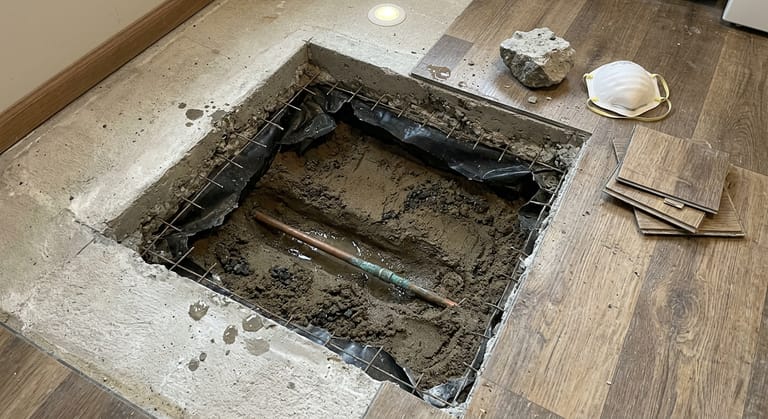
Cause one: clay that moves under the floor
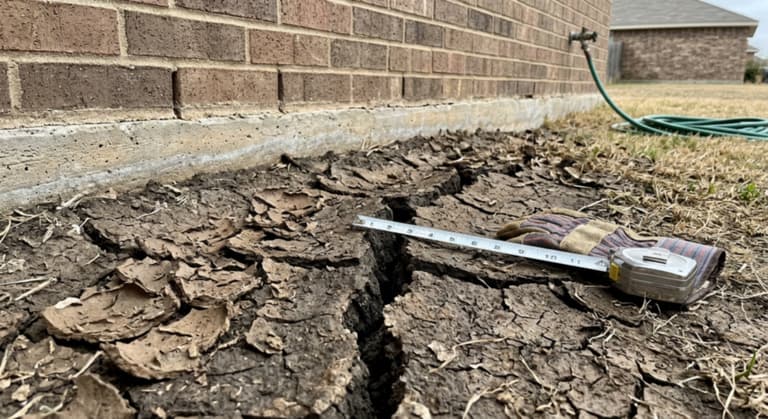
USDA NRCS grades soil swelling as linear extensibility: low below 3 percent, moderate 3 to 6, high 6 to 9, very high above 9. Above 3, the same text warns of harm to buildings, roads and other structures, and adds that the rating is no stand-in for a site geotechnical exploration and report.
The NRCS Soil Survey Manual is blunter still: what a survey interprets was never meant to settle a building question. A county rating is background, never a verdict on one lot.
Houston Black clay sits far past that. The NRCS series description puts clay content at 40 to 60 percent, and its vertic features entry records fissures half an inch to four inches across, running a foot down or further once the ground dries, standing open 90 to 150 cumulative days in most years. Ground that moves grips a buried line, then lets go.
The Arizona Geological Survey lists ruptured pipelines among the damage problem soils do. Nobody publishes how often; the mechanism is documented, the rate is not.
Cause two: water working on copper from the inside
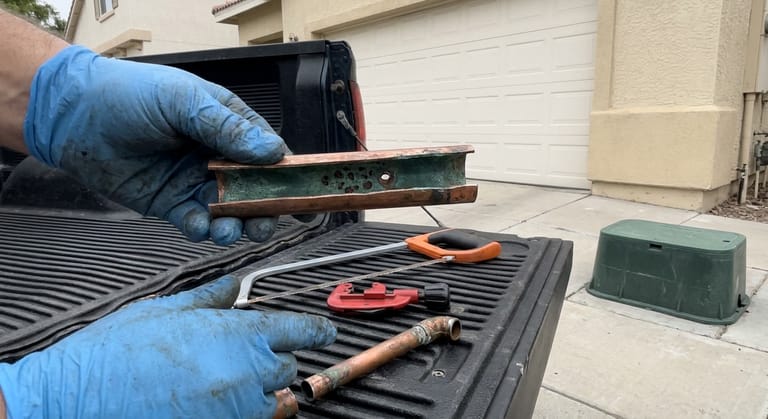
The Copper Development Association's tube handbook lists six causes of corrosion trouble, and only two involve the water supply:
- aggressive, hard well waters that cause pitting
- soft, acidic waters that never let a protective film form inside the tube
- design or installation producing excessive velocity or turbulence
- unacceptable workmanship
- excessive or aggressive flux
- aggressive soil conditions
CDA's pitting water has a signature: high dissolved solids with sulfates and chlorides, pH 7.2 to 7.8, carbon dioxide over 10 parts per million, dissolved oxygen present.
Hardness alone is a different measure. USGS grades water very hard above 180 mg/L as calcium carbonate, general guidelines rather than a standard, and USGS Circular 1332 adds that hard and very hard water often requires treatment. The 2021 AWWA Water Science review puts the national count near 750,000 pinhole failures annually, in a sentence ending "but we do not really know why".
Drop the belief that the hot line always goes first: in EPA's case-study community the pitting was limited to cold water plumbing. What CDA documents is a thinner margin on the hot side, a design ceiling of 8 feet per second cold against 5 hot to about 140F. That is why a hot line under the floor gets its own test.
Cause three: how the pipe was buried
Two houses share a street, a water main and a build year; only one floods. CDA points at the joint: aggressive flux left inside the tube can cause or intensify pitting, and overheating during soldering polymerizes it and makes the pitting worse.
Build year and local code tell a plumber what to expect on a free call, before a hole is cut.
Put it to someone who opens floors for a living
Call (800) 555-0142Costs nothing to dial. A licensed plumber who does slab work answers, not a scripted call center.Licensed partners who locate and repair slab leaks- Plumbers who locate the leak before anyone breaks concrete
- Someone picks up at 3 a.m. too
- No charge to call, no obligation to book
- Your quote comes from the plumber, with nothing added by us
Is water under the concrete dangerous
Not like a gas line: the harm is slower and lands on the house, with two exceptions. Mold is the first. EPA's window for drying wet material closes between the first day and the second, with a hedge attached: hit it and growth usually never starts.
Electricity is the second, and the Electrical Safety Foundation leaves no room: equipment pulled from water can hold a charge, so hands stay off it; flooded rooms wait on the power company; and whatever got wet is inspected before use.
Ruined flooring and cabinetry is the ordinary outcome, and locating the failure this week beats replacing a floor next month. Reading the meter and photographing damage is homeowner work; opening concrete is not. That conversation reaches no invoice, and (800) 555-0142 is picked up well after midnight.
How long a leak hides before anybody notices
Nobody counts it. No agency publishes how long water runs under a floor before somebody notices; in practice it turns on whether it ever finds an edge to surface at.
What EPA publishes is the scale of hidden loss. Its Fix a Leak Week page counts leaks of 50 gallons a day or more in nine percent of homes, and puts what leaks away in an average household above 9,300 gallons a year. USGS sizes one line: a gallon every 10 minutes into a house is 144 gallons a day, 52,560 a year.
Copper, PEX and what is actually down there
Nobody publishes an honest service life for copper under a floor. CDA gives no year count, only that a correctly designed and properly installed assembly "will easily last the life of the building". HUD's Estimated Useful Life Table lists copper or brass hard pipe at 75 years and copper tube at 50: two planning rows for multifamily capital budgeting, not measurements of pipe under concrete.
No source compares how often PEX fails down there against copper. What the material changes is the search. In a table EPA reproduces from a leak-detection contractor, a 2 gpm leak at 50 psi in a service line carries 600 to 1,000 feet along copper and 50 to 100 feet along poly plastic. Acoustic work on plastic is slower.
Which pipe ends up where is decided on the four repair routes and priced on what each one costs.
Post-tensioned floors change the rules
Some slabs hold steel tendons under tension. No authority counts how many houses sit on one, which is why the question gets asked before anything is opened. The 2024 IRC added a section sending post-tensioned slab-on-ground floors to the PTI standard DC10.5, and PTI's own repair page names coring and drilling among the things that lead to tendon failure.
Slab foundation leak: what to do in the next hour
All of it is homeowner work, and it stops before concrete.
- Shut the house down. Every tap off, dishwasher and washer idle, ice maker and irrigation off.
- Read the meter twice. Note the digits and the low-flow indicator, let a couple of hours pass using nothing, then read again. EPA's rule: a changed figure is a leak.
- Split hot from cold. A plumbing contractor in Texas spells the move out: taps closed, recirculation pump unplugged, then close the valve on the marked cold inlet, which that contractor puts at the upper right of the tank as you face it.
- Photograph the evidence. Warm patches, damp baseboard, the meter face, alongside what these failures look like in the field.
- Stop there. No cutting, no coring, no digging along the foundation. Locating comes first, and it is not a rental-counter tool.
A plumbing leak in a slab foundation gets pinpointed before anything is opened: one small hole, not a hallway of broken tile. HomeAdvisor's June 2026 page puts the normal range at $630 to $4,400, average $2,280.
Calling (800) 555-0142 puts nothing on a bill, and the plumber who answers chases slab leaks all week. Lead with the meter figure, which shortens everything after it.