What It Costs to Repair a Slab Leak, Start to Finish
The short version
- Slab leak repair cost lands between $630 and $4,400 for most homes: the normal range HomeAdvisor published in June 2026, against a $2,280 average. Fixr, dated May 2025, gives $1,000 to $4,000 as typical and $15,000 as its high end.
- The access route prices the job, not the broken pipe. HomeGuide bills breaking concrete at $500 to $3,000 and the replacement pipe at a separate $200 to $2,000.
- Finding it is its own line. HomeAdvisor lists $150 to $400 for locating and suggests planning on $280; one Texas company folds locating into the project price instead.
- Every per foot tunneling figure verified here came from a Texas contractor, and one of them says plainly that its tunneling estimate excludes the plumber's own bill.
- Two policy forms read for this page pay to open the floor and reach the escape point, then stop short of the pipe itself. Coverage still turns on your policy and your adjuster.
Slab leak repair cost runs $630 to $4,400 for most homes, the normal range HomeAdvisor published in June 2026, against an average of $2,280. What sets the number is the route to the pipe, not the pipe: three national pricing sites quote the same job and land in different places.
What the national price bands actually measure
Concrete slab leak repair cost arrives in three shapes: one finished job, access plus pipe, or a rate per foot. Reading a per foot number as a finished price is where sticker shock starts.
| Source and date | What it prices | Published figure |
|---|---|---|
| HomeAdvisor, June 2026 | Finished repair, national | $630 to $4,400 normal, $2,280 average |
| Fixr, May 2025 | Finished repair, national | $1,000 to $4,000 typical, $2,500 average, $600 low, $15,000 high |
| HomeGuide, October 2025 | Digging into the foundation, replacing damaged pipe | $700 to $5,000 |
| HomeGuide, October 2025 | Repairing by installing a pipe lining | $500 to $3,500 |
HomeGuide splits it further: breaking concrete or trenching to reach a badly damaged pipe is $500 to $3,000 alone, and the replacement section another $200 to $2,000, or $0.40 to $8.00 a linear foot by material. A cheap looking bid is often the second line without the first.
Ask which shape a number takes before comparing two bids. (800) 555-0142 answers that at no charge, with a licensed plumber who works under slabs.
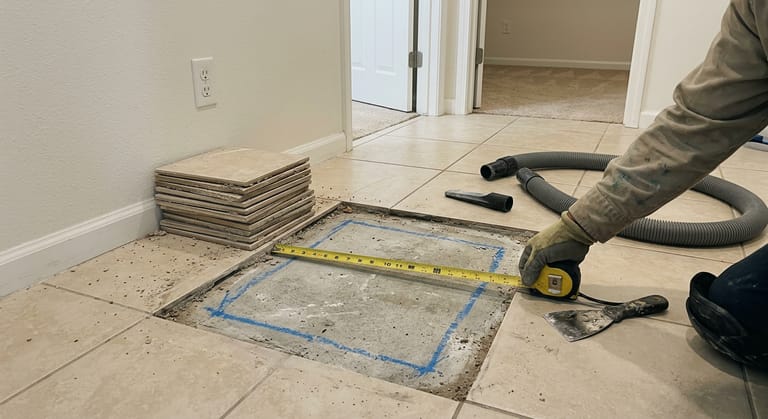
Cost to fix a leak under the slab, method by method
Sources disagree by method, so every figure stays tied to whoever printed it.
| Method | What happens | Published ranges, by source |
|---|---|---|
| Spot repair through the floor | Concrete opened over the failure | HomeGuide $500 to $3,000 access plus $200 to $2,000 pipe; Fixr $500 to $3,000; a Houston contractor $1,500 to $4,000 |
| Reroute overhead | Buried run abandoned, new line above | HomeGuide $3,900 to $7,500; HomeAdvisor $600 to $4,000; Fixr $4,000 to $15,000; a Houston contractor $2,500 to $8,000 in the attic |
| Lining or epoxy | Pipe coated inside, nothing excavated | HomeGuide $500 to $3,500, or $90 to $250 per foot cured in place; HomeAdvisor $80 to $250 per foot; Fixr $500 to $2,000 |
| Tunnel from outside | Digging beneath the foundation | Fixr $900 to $2,000 nationally in 2025; Texas firms price by the foot |
| Repipe the house | Whole supply system replaced | HomeGuide $2,000 to $15,000; $3,100 to $5,500 for an existing 2,000 square foot home |
Soil, pipe age and earlier failures decide which. The four repair methods and when each is chosen sit on the repair page, and reroute, epoxy and tunneling instead of breaking the floor has its own. Methods get ruled in or out over the phone, at no charge.
Slab leak detection cost, and whether it lands on a separate bill
Slab leak detection cost is published on its own by every source read here, and no two agree. HomeAdvisor lists $150 to $400 and says plan on $280; Fixr, May 2025, gives $100 to $400; a San Antonio contractor posts $150 to $600 for locating alone, April 2026. A Dallas company posts a flat $325, that firm's own price rather than a market rate; a Dallas-Fort Worth contractor absorbs locating into the job price.
Two items get confused with it. HomeGuide's $300 to $750 foundation inspection buys a look at the whole slab, not an electronic fix on one pipe. On its pipe leak page a diagnostic fee is $50 to $200 and a camera inspection $125 to $500, sometimes waived if the repair is booked.
Hot water slab leak repair cost, and what the hot side changes
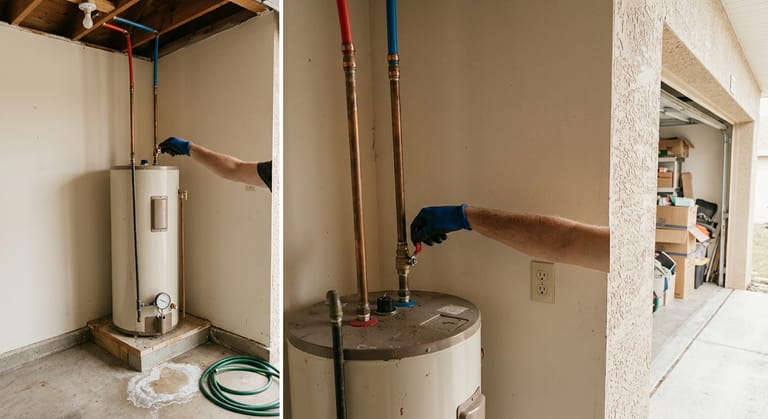
None of the national pricing sites read here puts a separate price on the hot side. What differs is design margin: the Copper Development Association caps cold water at 8 feet per second and hot at 5 as far as about 140F, dropping to 2 to 3 where water routinely runs hotter, and it singles out circulating systems for oversized pumps and undersized return lines.
Pricing follows the replacement route. The Dallas-Fort Worth contractor publishes $1,600 to $1,800 per water line drop, $5,000 to $7,000 per single line, and $8,000 to $9,000 for a bathroom reroute of five drops: two sink faucets, hot and cold shower lines, toilet. One company's March 2026 numbers, one market.
Isolating the hot side is free: close the cold feed into the water heater and watch the meter, a test set out on a hot water line leaking under the slab. If the dial stops, say so when calling.
What drives the price up or down
Once the method is settled, the cost of slab leak repair moves with three things: how much floor comes up, what it is made of, and how long the water ran unnoticed.
Flooring is the surprise, and no source prices it as a plumber's patch back line; what is published is what new flooring costs. HomeGuide's February 2026 figures put tile at $10 to $50 per square foot installed, luxury vinyl at $4 to $16, carpet at $2 to $8, with removal on top: $2 to $7 per square foot for tile, $0.70 to $1.60 for carpet. Many flooring contractors hold a minimum project fee of $200 to $500 or more, which hurts most on a small patch. Drywall cut for access adds $300 to $1,500 or more, a figure HomeGuide attaches to repiping.
Damage found late is its own budget. HomeGuide puts average mold remediation at $1,500 to $6,000; HomeAdvisor lists water damage repair at $500 for minor damage, rising to $15,000 or more where it is extensive. Labor runs $45 to $150 an hour on HomeGuide, $75 to $150 on HomeAdvisor, with HomeGuide pricing nights, weekends and holidays separately at $100 to $350 or more.
Put it to someone who opens floors for a living
Call (800) 555-0142Costs nothing to dial. A licensed plumber who does slab work answers, not a scripted call center.Licensed partners who locate and repair slab leaks- Plumbers who locate the leak before anyone breaks concrete
- Someone picks up at 3 a.m. too
- No charge to call, no obligation to book
- Your quote comes from the plumber, with nothing added by us
Why tunneling quotes swing hardest
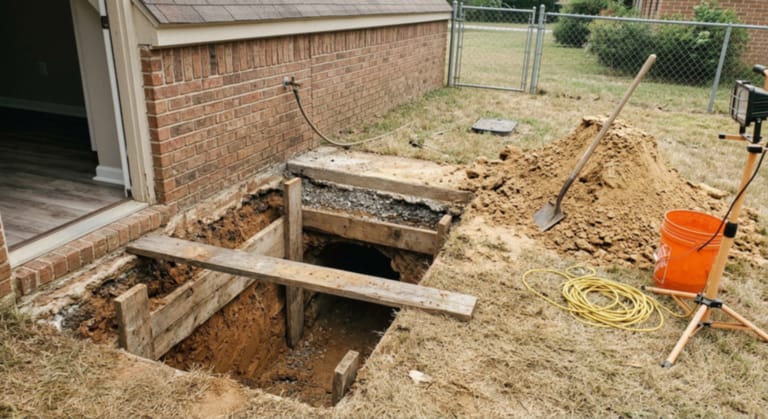
Tunneling is where two honest bids differ by five figures. Fixr, May 2025, prices tunnels at $900 to $2,000, the only figure here that is not regional. Everything else verified came from Texas contractors and runs higher.
A contractor in Bryan, Texas gives the going average as $200 to $500 per foot and its own rate as $400 to $500. The same firm publishes three job size tiers: roughly $2,200 and under where four feet of tunnel or less reaches a leak near the edge of the house, $4,500 to $7,000 where 8 to 15 feet reaches one nearer the center, and $24,000 upward where 60 feet or more takes in every waste line beneath the floor.
That page also works through one hall bathroom, landing lower at $3,000 to $5,000, but that is a worked example rather than a fourth tier: it covers tunneling plus backfilling in that firm's home market of central Texas. A Dallas company posts $4,200 for the first 10 feet plus $250 per additional foot; the Dallas-Fort Worth firm quoted earlier posts $8,400 to $9,200 per 10 linear feet.
Those numbers stay labeled by city, not blended. Regional detail sits on Dallas and Fort Worth, Orange County, where copper and water chemistry drive the work, and Oklahoma City and Tulsa on corrosive ground. Drains and sewer lines beneath the floor price differently, which belongs with under slab plumbing repair.
Tunnel length settles the bill, and nobody knows it until the line is located. Dialing (800) 555-0142 costs nothing and books nothing.
Will homeowners insurance pay for the work
No website can answer that for your policy. What regulators and the policy forms say about coverage is narrower, and useful.
The NAIC states that homeowners policies cover damage from a "sudden and accidental" discharge from a plumbing system, the quotation marks kept because the phrase is policy language. The Insurance Information Institute lists accidental discharge or overflow of water from a plumbing system among the perils an HO-3 covers, and writes separately that a standard policy will not pay for damage caused by a flood, earthquake or routine wear and tear. The California Department of Insurance puts "Sudden & accidental water damage" among perils generally covered, and water damage from seepage or leaks among those generally not.
Slab leak is a trade term, not a defined term in either form read here. The forms classify the event: an escape of water from a plumbing system that sits under the floor. Adjusters work from the written scope, the escape point and the access taken to reach it, so getting that on paper before concrete is cut costs nothing.
Asking the plumber to write the scope in those words is free, and (800) 555-0142 reaches one who will. Nobody here reads policies or files claims; that stays between you and your insurer.
What a hidden leak wastes while it runs
Every wasted gallon is metered. USGS puts a house water line losing one gallon every ten minutes at 144 gallons a day, or 52,560 a year. EPA reports leaks of 50 gallons a day or more in nine percent of homes, and sets an average household's annual waste past 9,300 gallons.
EPA pins its threshold to a billing period when nothing outside is being watered, January or February: a household of four pushing past 12,000 gallons over those weeks could have serious leaks. Add damage compounding unseen, and waiting stops being cheap. If the dial turns with every tap closed, (800) 555-0142 reaches a licensed plumber, free to call.
What belongs in the estimate before concrete gets opened
HomeGuide's buyer questions translate into a phone script.
- Ask who removes the debris. Broken concrete has to leave the property; confirm disposal is in the price.
- Ask what the number includes. Labor, materials and disposal fees, itemized, so two bids compare.
- Ask about the permit. A plumbing permit runs $30 to $500 on HomeGuide's national figures and many contractors include it; the Dallas-Fort Worth contractor puts its own final fee at $150 to $300. A permit fee is what a city charges, not a repair price.
- Ask what is excluded. That same company states drywall repairs are not included in the price of plumbing work, and that its direct repair range assumes one access point.
- Ask what would change the price mid job. A second failure point, a tensioned floor, or water in the subfloor rewrites the scope.
A plumber who answers all five plainly is usually the one to hire; how slab leak plumbers get checked covers license lookups by state.
Getting a number that fits your own floor
Published bands narrow guesswork; they cannot locate a pipe. Any slab leak repair cost worth acting on arrives after somebody isolates the line, pinpoints the failure and sees what covers the floor.
Call (800) 555-0142 at any hour and a licensed plumber who works under slabs answers; nothing charged, nothing booked. Have the meter reading, the month the bill jumped, and what covers the floor in the wet room: that is most of an estimate before anybody drives out.
Put it to someone who opens floors for a living
Call (800) 555-0142Costs nothing to dial. A licensed plumber who does slab work answers, not a scripted call center.Licensed partners who locate and repair slab leaks- Plumbers who locate the leak before anyone breaks concrete
- Someone picks up at 3 a.m. too
- No charge to call, no obligation to book
- Your quote comes from the plumber, with nothing added by us