Hot Water Leak Under a Slab, Settled at One Valve
The short version
- Isolate the tank and the hot lines drop out of the meter reading. A Texas plumbing firm sets out the prerequisites for that valve step; what the dial does afterwards is the trade's own inference, not that contractor's claim.
- Design margin, not failure order: the Copper Development Association drops its ceiling from 8 feet per second on cold copper to 5 on hot, and to 2 to 3 in systems that routinely exceed 140F.
- Less margin is not a verdict. EPA found the pitting in its case-study community limited to cold water plumbing, and calls temperature's effects difficult to generalize.
- Heated water lost under concrete gets billed twice over, by the meter and by the burner. EPA's Statistics and Facts page counts 9,400 gallons a year from an average family's household leaks.
- A warm floor whenever the heat runs is radiant heating tubing, a different pipe and a different trade from the potable water lines under the same concrete.
A hot water leak under a slab is proved at one valve: with every faucet off, close the cold inlet feeding the heater and watch the dial. Dial stops, the loss is on the hot side. HomeGuide puts rerouting instead of digging into the slab at $3,900 to $7,500.
A warm patch underfoot is a clue, not a verdict: heat climbs through fill and concrete first, so a hot line can go months without warming a floor.
The one valve that separates the sides
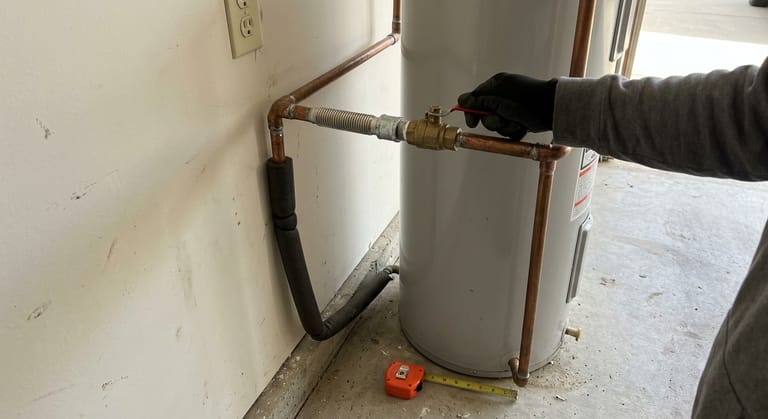
A Texas plumbing firm sets out this valve step, no tools, with two conditions ahead of it: no faucet anywhere left cracked open or dripping, and any recirculation pump unplugged. What the dial does afterwards is the trade's own inference, not a claim on that contractor's page.
- Shut the house down. Dishwasher and laundry idle, ice maker off, nobody drawing anything.
- Unplug the recirculation pump if one is fitted. A loop in motion keeps a dial turning for reasons unrelated to a broken pipe.
- Close the cold supply valve on the heater, the one on the inlet marked cold; on many tanks that is the top right as you face it, the way one Texas contractor describes it.
- Photograph the meter, wait, photograph it again, then reopen the valve: an isolated tank feeding a broken hot line empties itself. Compare images, not memory.
Dial stopped: the loss is on the hot side. Dial still creeping: the hot lines are cleared and the search moves to the cold half or a fixture. Neither answer says where the pipe broke, only where to sound.
Meter faces differ, and which dial to watch sits in the five-check protocol for finding a leak under concrete.
That much is yours, free and done in socks. Pinpointing the break below the concrete is gear work. Nothing is charged for dialing (800) 555-0142, and the plumber answering says what a stopped dial changes.
Why the hot side gets suspected first
The Copper Development Association writes ceilings for designers, not failure rates: no more than 8 feet per second on cold water in copper tube, 5 on hot to roughly 140F, and 2 to 3 where it runs hotter still. CDA also singles out circulating systems, calling oversized pumps and undersized return piping common occurrences, and warns that an acceptable velocity plus somewhat aggressive chemistry can cause trouble neither factor would produce alone.
EPA stays hedged on heat, and both halves of its sentence count. Higher temperature can exacerbate copper corrosion, it writes, although elevated temperature has in some instances been found to encourage a better passivating scale inside the pipe, and temperature's impacts are difficult to generalize.
Signs that lean toward the heated line
| What the house is doing | What it points at | What weakens it |
|---|---|---|
| One patch of floor warm day and night | Heated water spreading below concrete | A dial still moving with the heater isolated |
| Hot water thinner than it was, heater cycling more | Heated water leaving before it reaches a tap | A tired element or thermostat does this too |
| Running water audible with taps closed | Flow somewhere under pressure | Names no side by itself |
| Whole floor warm whenever the heat runs | Radiant heating tubing, not a supply line | Different pipe, different trade |
A phone thermal camera finds warm ground faster than bare feet, though EPA is even-handed: it reads temperature differences caused by saturation, those differences may not be large, it says nothing about the size of the leak, and groundwater can mask it.
Two rows agreeing means a phone call, not a project. Where warmth ranks sits in the seven signs, and the two that fool people.
Put it to someone who opens floors for a living
Call (800) 555-0142Costs nothing to dial. A licensed plumber who does slab work answers, not a scripted call center.Licensed partners who locate and repair slab leaks- Plumbers who locate the leak before anyone breaks concrete
- Someone picks up at 3 a.m. too
- No charge to call, no obligation to book
- Your quote comes from the plumber, with nothing added by us
What a heated line spends while the decision waits
Every gallon lost from a heated branch gets billed twice, by the meter and by the burner that warmed it for no tap. EPA's WaterSense Statistics and Facts page puts an average family's household leaks at 180 gallons a week, or 9,400 a year, and that covers ordinary leaks, not a pipe running unwatched below a floor.
Waiting also moves the bill from plumbing toward flooring, since cabinets and subfloor sit in the wet zone. Prices by method and access are in what slab leak repair costs.
Radiant heat leak in concrete slab: another pipe entirely
A radiant heat leak in a concrete slab is a heating fault, not a supply fault. Hydronic floors circulate heated fluid through tubing cast into concrete to warm the room, and the residential code files them apart: piping for embedment in concrete belongs to the hydronic chapter, IRC Chapter 21, not to the potable water sections.
That repair belongs to a hydronic heating contractor; pointing one trade at the other's pipe wastes the visit.
How a leaking hot branch usually gets repaired
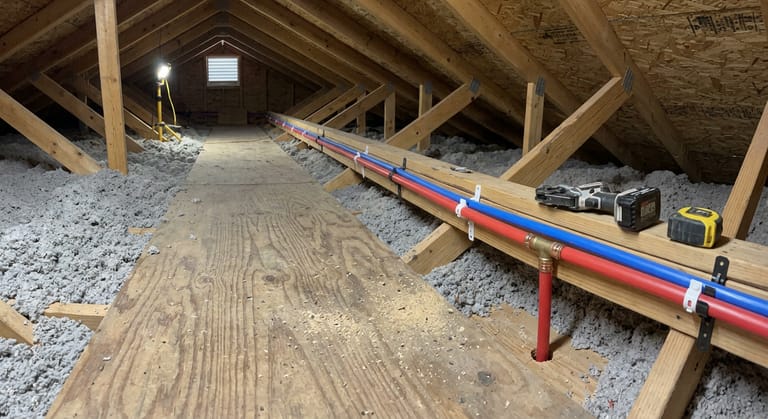
Abandoning the buried branch for new pipe overhead is the routine answer: every joint goes back within reach. Prices differ by company and market: a Houston contractor posts $2,500 to $8,000 for rerouting through the attic, a San Antonio contractor lists $2,000 to $4,500 for new lines through walls or ceilings, and HomeGuide's national figure for rerouting is $3,900 to $7,500.
Where new pipe leaves or re-enters concrete, UPC 312.10 requires sleeves protecting piping through concrete floors and masonry walls.
Spot repair, lining and tunneling all stay open until the leak is pinpointed, and that pinpointing starts with a free call; the four routes are compared in repairing a leak beneath the concrete.
Where the homeowner stops and the licensed work starts
Reading a meter, closing a heater valve, photographing a warm patch, drying what is wet: all yours. Sounding concrete, opening a floor, brazing pipe: licensed work, however handy the owner is.
Where the tank lives out in the garage, a wet floor there has innocent explanations. Rule those out in water on the garage floor first.
Then make the call. (800) 555-0142 is open around the clock and reaches a plumber holding a license in your state, one who works on slabs instead of reading a script: say whether the dial stopped with the heater isolated, describe the warm patch, name the floor covering. Artistic Plumbing is a publication with no plumbing license of its own. When a call turns into scheduled work, that plumber's office credits this site a set referral fee at the firm's own expense, which is why your estimate looks the same either way.