Seven Signs of a Slab Leak, Ranked by What They Prove
The short version
- The meter outranks everything else. EPA has households take a reading, sit through 120 idle minutes, and take a second one; any gap between the two points at a leak.
- A warm floor patch points at the hot line. CDA holds hot water copper to 5 feet per second up to about 140F against 8 for cold, so the hot side carries the thinner design margin.
- Money moves early. EPA counts nine percent of homes losing 50 gallons a day or more, and a municipal chart rates a 1/16 inch hole at 60 psi at 822 gallons a day.
- Sound is evidence, not proof. EPA describes two noise bands, 500 to 800 Hz through the pipe and 20 to 250 Hz through the ground, and warns a big old opening can be quieter than a small new one.
- Two wet floors mimic the real thing: a water heater standing in the garage, and rainwater arriving at the foundation. Neither is a pipe under the slab, and each has its own quick check.
Three signs of a slab leak hold up in the field: a meter creeping with every tap shut, a warm floor patch, and a bill that climbed with no habit change. The other four below are softer, and the 2 most common wet floors in a house on concrete are not plumbing at all. Work the list in order, because the first check costs nothing and closes most cases before anyone opens a floor.
Slab leak symptoms ranked by how much each one proves
Slab leak symptoms do not carry equal weight, and treating them as equal is how people pull flooring in the wrong room. A pressurized line escaping under the slab announces itself twice: at the meter, and at the surface wherever water finds a path up. The seven signs of a slab leak below sit in that order of proof.
| What you notice | What it points at | Weight |
|---|---|---|
| Meter moves with the house shut off | Escape on the pressurized side | Strongest, and free |
| Warm patch in one spot of floor | The hot line below | Strong if it stays put |
| Bill climbed, nothing changed | A loss running day and night | Strong with the meter |
| Water heard in a quiet room | Pressurized escape nearby | Silence proves nothing |
| Damp carpet edge, dark grout | Water that reached the surface | Misleading on position |
| Musty air in one room | Moisture that has run a while | A late sign |
| Pressure down across the house | Many possible causes | Weakest, support only |
Two hits up top and the guessing is over. One from below means read the meter tonight.
Sign 1: the meter keeps moving with everything shut off
The cheapest diagnostic in plumbing belongs to a federal agency. EPA's Fix a Leak Week page sets it out in three moves: take a meter reading, let 120 minutes pass with every tap idle, take it again. Any gap between the figures, however small, means water is going somewhere.
The Portland Water Bureau describes what to watch. Leak detection dials come in two patterns, the bureau writes, a triangle printed red or blue and a snowflake printed blue, and a drip nudges either one so gently the movement is easy to miss. Where the hand looks frozen, mark it, leave taps and irrigation alone for several hours, then check again: a hand that has crept is what the bureau calls a slow leak.
- Shut the house down. Faucets, dishwasher, washer, ice maker and irrigation off. A running toilet flapper fakes the test.
- Read the meter and photograph it. A plumber reads a dial photo in seconds.
- Wait two hours, touching no tap. Overnight is better if the household can manage it.
- Read it again. If it changed at all, EPA's line is that you probably have a leak.
That is the homeowner half of the job. What the reading means costs one free phone call.
Sign 2: a warm patch on the floor that stays in one place
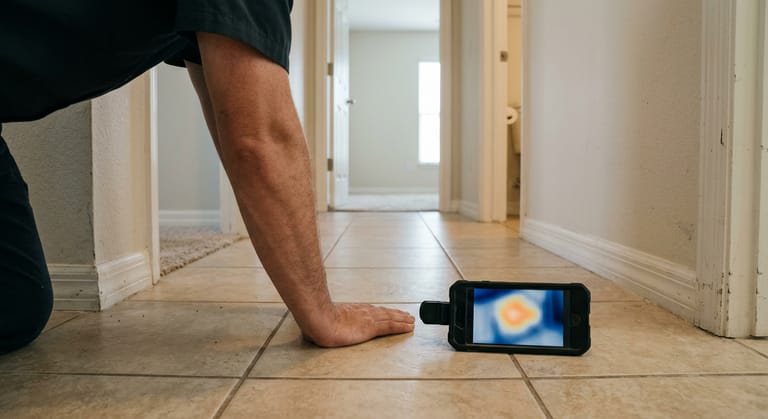
Floor that reads warm underfoot in a house with no radiant heating points down at the hot water line. The Copper Development Association sets design ceilings of 8 feet per second for cold water in copper tube and 5 for hot water to roughly 140F, tightening to 2 to 3 where water runs hotter, and singles out circulating hot systems for constant flow and heat. Thinner margin, more hours of duty. CDA does not say hot lines fail first, and neither does this page, but the warm patch earns its own test.
A Texas plumbing outfit writes up the isolation step: with every faucet fully off and any recirculation pump unplugged, shut the valve on the cold inlet where it enters the heater, a connection that firm places high on the right as you face the tank. What the meter does next is how plumbers split the sides: a dial that halts puts the escape on the hot run; a dial still creeping clears that half of the house. Detail sits on the page about a hot water line failing under the slab. Turning that patch into a marked spot is gear work, not homeowner work, and asking costs nothing.
Sign 3: the bill climbed and nothing else changed
EPA counts leaks in nine percent of homes that throw away 50 gallons a day or worse, and puts the average household's yearly waste above 9,300 gallons. Its screen is worth borrowing: a family of four exceeding 12,000 gallons in a colder month such as January or February, when outdoor use is low, could have serious leaks.
The City of Pratt, Kansas publishes a municipal leak chart rating a 1/16 inch hole at 60 psi line pressure at 0.5710 gallons per minute, 822 gallons per day and 300,111 per year.
Sign 4: water running when every tap is closed
Water heard moving in a quiet room is real evidence. EPA's guidance on distribution losses, document 816-R-10-019, describes exactly two noises. The shockwave as water is forced through the opening normally sits in the 500 to 800 Hz range and travels through pipe and water alike, carrying hundreds of feet. A second band, 20 to 250 Hz, is generated where the escaping stream strikes the pipe bedding; it moves through soil, fades fast, and fixes position.
EPA wrote that for utilities surveying buried mains, not houses. It also turns the usual intuition around: it is not unusual, EPA says, for larger leaks to generate both lower frequency and lower noise intensities than recently formed, smaller ones.
Signs 5, 6 and 7: damp edges, musty air, soft pressure
These three arrive late and are worth little alone.
Damp shows up where the floor lets it, not where the pipe failed. A wet carpet edge or a dark grout line proves water exists; neither is an address.
Musty air belongs to time rather than volume. The way to control indoor mold growth is to control moisture, EPA writes, with indoor humidity down at 30 to 60 percent, and its mold guide closes the drying window on the second day: material dried before then will in most cases not grow mold. Falling pressure is weakest of the set: a regulator, a partly closed valve, scaled fixtures or a municipal issue all do it.
Put it to someone who opens floors for a living
Call (800) 555-0142Costs nothing to dial. A licensed plumber who does slab work answers, not a scripted call center.Licensed partners who locate and repair slab leaks- Plumbers who locate the leak before anyone breaks concrete
- Someone picks up at 3 a.m. too
- No charge to call, no obligation to book
- Your quote comes from the plumber, with nothing added by us
Water leak in a concrete slab floor: what reaches the surface
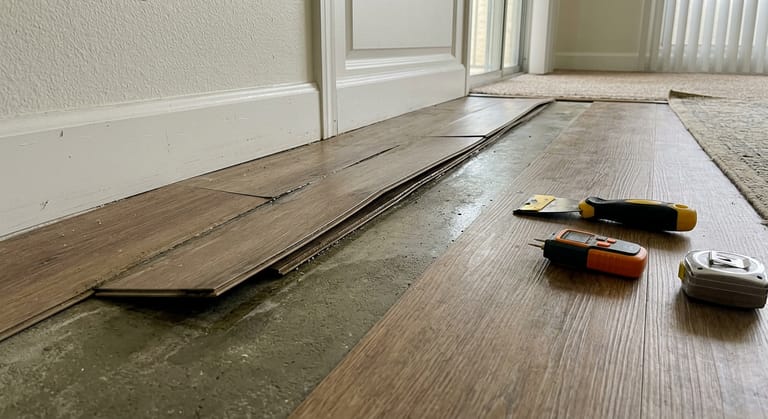
A water leak in a concrete slab floor rarely arrives as a puddle. Concrete is porous and routinely cracked, so water leaves by the easiest path: expansion joints, the seam where floor meets footing, pipe penetrations, the gap under a baseboard. What a homeowner sees is a floor that stopped behaving. Tile hollow in one square. Laminate lifting at the seams while the rest stays flat. Wood cupping in a stripe. Photographs of each sit on the slab leak pictures page.
Concrete slab leak detection: the gear that finds the spot
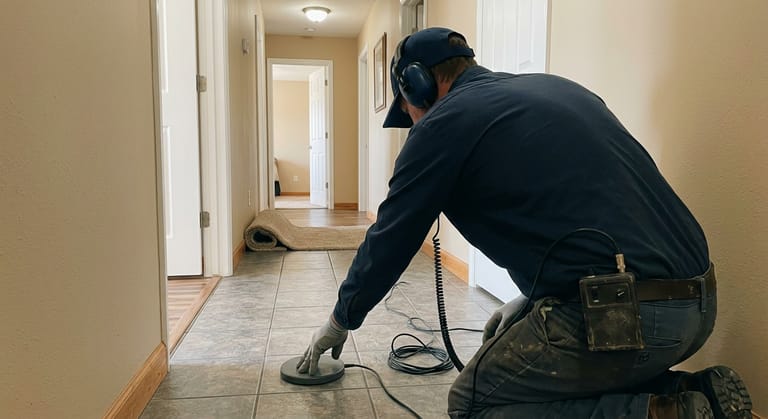
Concrete slab leak detection is where the job leaves the homeowner's hands. Leak detection in concrete slab work runs on three instrument families, all of them in the same EPA guidance for utilities working buried mains.
Acoustic tools listen. Geophones, EPA notes, are best used for leak sounds propagated largely through the ground, the band that pinpoints position. Correlators put sensors either side of the suspected point and compare arrival times; EPA's table logs the result in metric shorthand, "Not unusual for the accuracy of leak locate to be better than 1m/100 meters".
Thermal imaging hunts the temperature difference saturated ground creates, with three weaknesses EPA names: the contrast may be faint, the image is silent on the escape's size, and groundwater hides it easily. Tracer gas is the fallback where both fail, a 5 percent hydrogen and nitrogen mixture pushed into the line and read above ground, though EPA is candid that gas proves a leak exists better than it locates one.
Slab leak detection near me: what the first hour looks like
Searching slab leak detection near me at 11 p.m. usually means the dial has already moved. What follows is standard among partner plumbers. Meter and main valve first, then fixtures isolated so toilets and irrigation stop poisoning the reading, then hot and cold split at the water heater. Only then does gear come out, sounding the floor along probable pipe runs and narrowing to a marked spot. Access and method are priced before anything is cut: spot repair, reroute above ground, or tunnel underneath.
Who does which part, what a license means in your state and the questions worth asking sit on the page about choosing a plumber for slab work. The call itself is free and reaches a plumber licensed where you live.
Two wet floors that fool almost everyone
Water on a garage floor near the shared wall is the first impostor. Where the water heater stands in the garage, a weeping tank, a relief valve or an air conditioner condensate line wets the same concrete a failed pipe would. The ten minute check sits on the garage floor page.
Rain is the second. Water at the foundation after a storm that dries up in a settled week is groundwater, not plumbing, and the meter sits still through it. A loss that runs in dry weather and moves the dial is the other animal, and the groundwater or plumbing fork says when the right call is a waterproofing contractor instead.
What causes a leak under a slab
Soil does much of it. NRCS classifies shrink swell potential by linear extensibility: low below 3 percent, moderate 3 to 6, high 6 to 9, very high above 9, and says that above 3 percent shrinking and swelling can damage buildings, roads and other structures. Survey data, the same guidance adds, does not replace a geotechnical report for one property.
Water chemistry does the rest. CDA describes the aggressive well waters that pit copper as carrying high dissolved solids including sulfates and chlorides, a pH between 7.2 and 7.8, carbon dioxide above 10 parts per million and dissolved oxygen. The long version is on what these failures actually are.
Two signs line up: how to find the leak from here
When two signs of a slab leak agree, the next hour goes on narrowing rather than opening. The protocol, meter isolation through hot side separation, listening and moisture reading, is written out on how to find water under a floor. Where water is actively rising or the ground feels soft underfoot, run the emergency sequence instead: main valve off, photographs, and no contact with standing water while the supply is still live, on the water under concrete right now page.
If the dial moved tonight, call (800) 555-0142. The first question will be what it did across those two hours, and the conversation is free.
Put it to someone who opens floors for a living
Call (800) 555-0142Costs nothing to dial. A licensed plumber who does slab work answers, not a scripted call center.Licensed partners who locate and repair slab leaks- Plumbers who locate the leak before anyone breaks concrete
- Someone picks up at 3 a.m. too
- No charge to call, no obligation to book
- Your quote comes from the plumber, with nothing added by us