Slab Leak in the Garage, or the Water Heater Standing Next to It
The short version
- Four things wet a garage floor: a pressurized line failing under the slab, the water heater standing on it, an air conditioner condensate line, and rain arriving at the door.
- The meter sorts them out. With every fixture shut, a low flow indicator that keeps turning means water is leaving the system somewhere below.
- A wet ring around the tank proves nothing by itself, since the heater stands on the same concrete a buried line would surface through.
- Garages sit under a code exception: the 2021 IRC lists them first among the exceptions to its vapor retarder rule, so this floor shows damp readily.
- One of the four causes ends in opened concrete, and the pipe gets located before anything is cut.
A slab leak in the garage is one of four things that put water on that floor, and the water meter tells them apart in about 10 minutes. The other three: the heater standing there, an air conditioner condensate line, rain under the door.
The 10 minute check for a garage slab leak
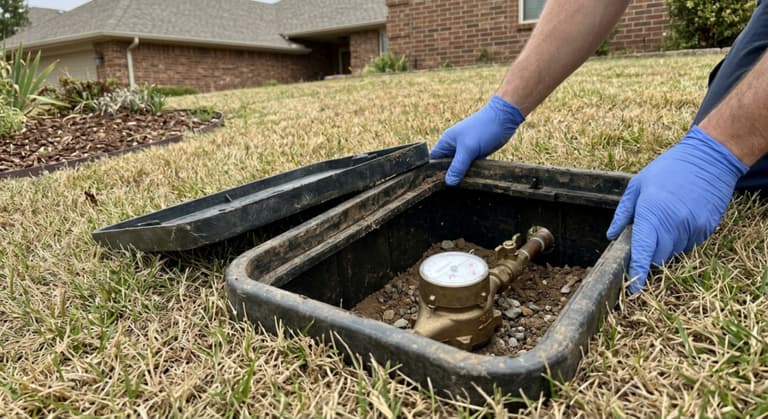
No tools, and it produces the evidence a plumber asks for.
- Shut everything that draws water. Faucets, ice maker, irrigation, washer. A toilet running at the far end of the house imitates every cause here.
- Read the meter, not the puddle. Most registers carry a small leak indicator, cut as a triangle on some makes and a snowflake on others. Photograph where it sits.
- Shut the heater's cold feed. A Texas plumbing firm walks homeowners through it, a practitioner rather than an agency: the handle sits on the incoming line above the tank, with every faucet closed and a recirculation pump unplugged first.
- Read the indicator again. Plumbers score the second look this way: a dial that keeps turning puts the loss on the cold side, one that halts puts it on the hot side or the heater.
- Give a slow leak longer. EPA runs its version across 120 quiet minutes and calls the faintest twitch a leak. Portland stretches that out: chalk the hand's position, draw nothing for half a day, look again.
Mop dry, tape the wet edge, watch how fast it returns.
Reading the result: four causes, four different bills
| Indicator behavior | Likely source | Next move |
|---|---|---|
| Turns with every tap closed, keeps turning with the inlet shut | A cold line losing water below the slab | Licensed locate before concrete is opened |
| Moves, then stops with that inlet closed | The hot side, or the heater's own fittings | Narrow it on the hot line under the slab |
| Still through both tests, floor wet anyway | Condensate, tank sweat, relief valve discharge | Watch when the wet appears, not where |
| Still, and wet only after rain | Drainage, grading, the door threshold | Sorted on groundwater or a failed line |
An indicator that moves with everything off is a garage slab leak until proven otherwise. Dial (800) 555-0142 and read your photos out loud: no charge attaches, someone who pinpoints these losses hears your numbers instead of a web form, and the answer is a visit today or a test tomorrow.
When the garage water heater is the source
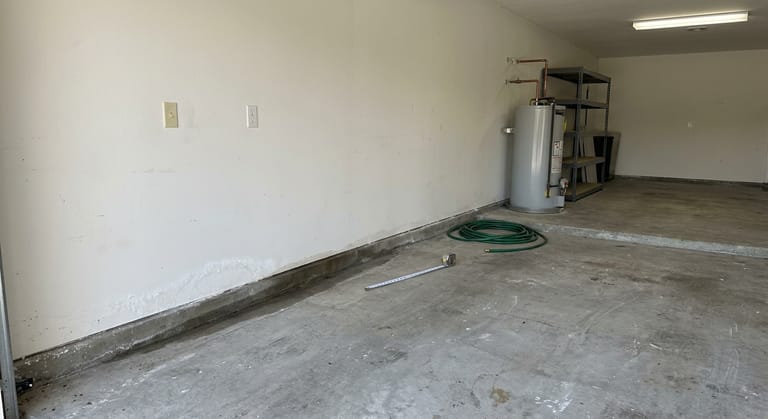
A tank wets concrete in ways unrelated to buried pipe: the seam where shell meets base, the stub carrying relief valve discharge toward the floor, the fittings on top. Humid weather adds condensation, which drips without moving the meter.
Direction is the tell: heater water starts under the tank and runs downhill, while a slab leak surfaces wherever the concrete lets it go.
Photograph, dry, isolate: the owner's half ends at anything energized and at the concrete. Nothing is billed for dialing, and whoever answers spends working days locating losses beneath garage floors.
Put it to someone who opens floors for a living
Call (800) 555-0142Costs nothing to dial. A licensed plumber who does slab work answers, not a scripted call center.Licensed partners who locate and repair slab leaks- Plumbers who locate the leak before anyone breaks concrete
- Someone picks up at 3 a.m. too
- No charge to call, no obligation to book
- Your quote comes from the plumber, with nothing added by us
Condensate, rain, and the vapor retarder a garage may not have
Air conditioning makes water on purpose. The condensate line drains by gravity, so a clog puts clean water on the floor. Timing is the test: shut the system down for an hour on a hot afternoon and watch the edge.
Rain writes a different signature: water at the door line within hours of a storm, dry again midweek, meter never moving. Drainage, not plumbing.
A code exception is not a reading of your own floor. Damp that never moves the meter is a moisture problem, not a plumbing one. Killing the AC for an hour is yours to do; deciding the slab comes up is not, and asking costs nothing.
What a slab leak in the garage looks like
Rarely a spreading pool. More often:
- a dark line along the wall the garage shares with the house
- one strip staying damp while the rest of the floor dries
- white mineral bloom low on the wall
- a patch that reads warm underfoot, pointing at the hot line
Size is easy to underestimate. Ten minutes to the gallon works out, on USGS arithmetic, to 144 gallons daily and 52,560 across a year. EPA finds leaks of 50 gallons a day or worse in nine percent of homes.
Two pages go further: the seven signs, ordered by what each one proves and photographs of each stage. When both point the same way, dial.
If the garage smells like gas
What the call gets you
Locating bills separately from repair. HomeAdvisor's national page, updated June 19, 2026, lists $150 to $400 and tells readers to plan to spend $280; Fixr, last updated May 1, 2025, puts it at $100 to $400. Ask whether the fee folds into the job.
Narrowing the loss to a length of pipe precedes any cutting. The homeowner walk-through lives on tracing the wet line under your floor, and the questions to ask are on who handles slab work.