Fix a Slab Leak Without Jackhammering the Floor
The short version
- Publishers disagree by multiples on one job name. HomeGuide averages a reroute at $3,900 to $7,500, HomeAdvisor lists $600 to $4,000, Fixr $4,000 to $15,000.
- Lining is the only route that opens nothing. HomeGuide prices cured-in-place lining at $90 to $250 per linear foot, HomeAdvisor at $80 to $250.
- Tunneling prices found at source are Texan. Fixr's $900 to $2,000, from its May 2025 update, is the one national figure.
- Cutting concrete stays in the running: HomeGuide puts slab access at $500 to $3,000, well under its own reroute average.
- On a post-tensioned slab nothing is drilled until the tendons are located, and no tendon is cut except under an engineer's design.
Partner plumbers fix a slab leak without jackhammering in three ways: an overhead reroute, a lining set inside the pipe, or a tunnel driven under the house from outside. HomeGuide prices a reroute at $3,900 to $7,500 and a pipe lining at $500 to $3,500, against $500 to $3,000 to break concrete open.
None is automatically cheaper than cutting: the pipe's location, the floor finish and the locating gear decide.
The three routes that leave your floor whole
| Route | What it touches | What one source prices it |
|---|---|---|
| Overhead reroute | Old run abandoned, new pipe overhead, drywall opened at the drops | HomeGuide, $3,900 to $7,500 |
| Pipe lining | Existing pipe stays put, coated from inside | HomeGuide, $500 to $3,500 for the job |
| Tunnel from the yard | Soil removed under the foundation, floor untouched | Fixr, $900 to $2,000, updated May 2025 |
| Cutting the slab | Floor opened over the leak, then patched back | HomeGuide, $500 to $3,000 for access alone |
Those figures come from different publishers on different dates, describing no shared job. Read each as that publisher's own, then the wider picture in what slab leak repair costs.
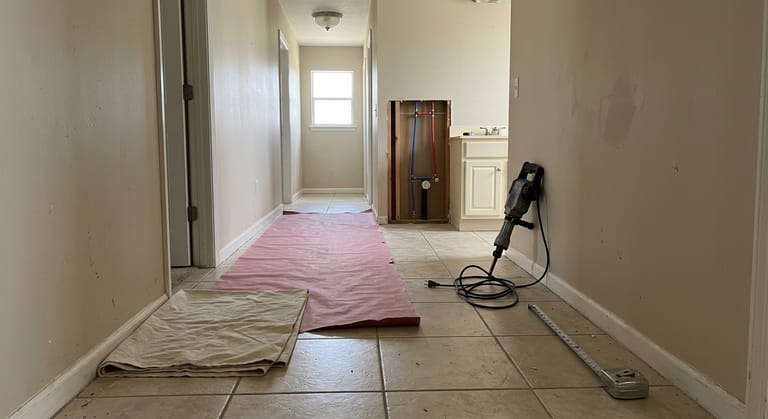
Reroute: abandon the buried line, run new pipe overhead
A reroute gives up on the leaking section: the plumber caps it, runs fresh pipe through the attic or a wall chase and drops it to each fixture, so water never returns to the concrete.
Code explains part of the appeal. In UPC jurisdictions, section 609.3 requires copper tubing under a slab to go in without joints where possible, brazed with wrought copper fittings where a joint is allowed. A reroute puts every joint back where a hand can reach it.
Prices split wide. HomeGuide averages $3,900 to $7,500 and calls rerouting complex but less invasive than digging a foundation. HomeAdvisor, updated June 2026, lists $600 to $4,000 under the same job name. Fixr reads $4,000 to $15,000, a row equal to whole-house replacement in its own table.
Your part takes ten minutes: shut the main valve, note whether the damp slab feels warm, photograph the ceilings a new run would cross. Stop at the ladder. Dialing (800) 555-0142 bills you nothing, and whoever picks up will say whether an overhead run suits your roof.
Trenchless slab leak repair: coat the pipe from inside
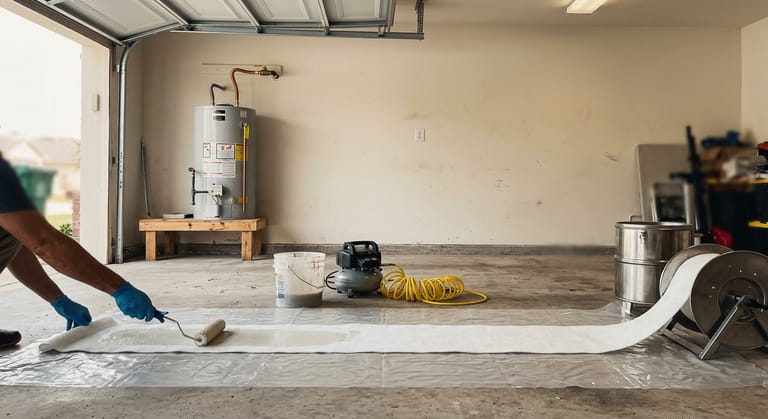
Trenchless slab leak repair keeps the leaking pipe where it lies. HomeGuide describes cured-in-place lining as coating damaged piping from inside instead of digging it up, prices it at $90 to $250 per linear foot, and calls it expensive but free of excavation. HomeAdvisor lists $80 to $250 per linear foot, Fixr's lining row $500 to $2,000.
A pinhole in a pressurized copper branch is a different animal from a cracked drain, which is why drains get their own treatment in under-slab drain and sewer work.
Your side stops at the valve and the description. Whether a liner fits is a camera call, free to ask for on the line above.
Tunneling: reaching the pipe from the yard
Tunneling sends a crew under the foundation from outside, so the pipe gets replaced with tile and cabinets untouched. It is the priciest quiet route and the hardest to price: nearly every published figure is Texan.
Fixr's $900 to $2,000 is the one national figure, updated May 2025. Anchor Foundation Repair in Bryan, Texas calls $200 to $500 per foot the market average. One Dallas contractor posts $4,200 for the first ten feet plus $250 per added foot; a Dallas-Fort Worth firm charges $8,400 to $9,200 per ten feet.
Code fences the excavation alongside the house: IRC P2604.4 says trenching parallel to footings and walls must not extend into the bearing plane of a footing. Nobody digs this one at home; ask the partner plumber on the free line which routes your yard allows.
Which route the pipe picks, not the homeowner
The decision to fix a slab leak without jackhammering belongs to the pipe, the soil and the finish overhead.
Quiet routes earn their price when
- The failure sits deep under tile, stone or fitted cabinets
- The same line has failed more than once
- The foundation is post-tensioned
Cutting the slab wins when
- One pinhole sits near an outside wall under vinyl or bare concrete
- The finish above is cheap to lift and lay back
- No attic route exists, as in a low-roofed single-story house
Neither list settles your house. The located leak does, and the plumber reads it out.
Put it to someone who opens floors for a living
Call (800) 555-0142Costs nothing to dial. A licensed plumber who does slab work answers, not a scripted call center.Licensed partners who locate and repair slab leaks- Plumbers who locate the leak before anyone breaks concrete
- Someone picks up at 3 a.m. too
- No charge to call, no obligation to book
- Your quote comes from the plumber, with nothing added by us
When the jackhammer is still the cheaper answer
HomeGuide puts opening the slab at $500 to $3,000 and the pipe replacement separately at $200 to $2,000. Against a reroute averaging $3,900 to $7,500 on the same page, one pinhole in an unfinished utility room makes no case for going overhead.
Texas numbers climb from there. A Houston contractor posts $1,500 to $4,000 for breaking through; a Dallas-Fort Worth firm prices most direct slab repairs at $7,000 to $9,000, adding that this assumes one access point and does not fully cover concrete remediation.
Post-tensioned slabs: nobody drills first
On post-tensioned concrete a reroute or a tunnel is no longer the expensive option but the sane one.
Floors, cabinets and the bill after the plumber
Patch-back is a separate trade with a separate bill. HomeGuide's pipe leak page puts floor repair after a leak at $200 to $1,200 for minor work and $500 to $6,000 or more for major. Its February 2026 flooring guide shows the parts: tile removal at $2 to $7 per square foot, new tile installed at $10 to $50, and a $200 to $500 floor many contractors set on any job, painful on small patches.
Set that against the plumbing line items above: on vinyl or bare concrete the floor is cheap to lay back and cutting wins, on stone tile the putting back can outrun the pipe work.
What to ask before agreeing to any route
- Who removes the debris. HomeGuide tells homeowners to ask whether hauling the concrete away is priced in or billed afterwards.
- Who pulls the permit. HomeGuide puts a plumbing permit at $30 to $500 and notes many contractors fold it in; a Dallas-Fort Worth contractor lists its own closing charge as $150 to $300.
- What else could appear. HomeGuide's list ends by telling homeowners to ask what other expenses to expect. Ask it about patch-back, and about a second access point if the first one misses.
- Which route, and why not the others. A quote written before the leak was located is a guess wearing a number.
Those four work on any quote, including ones from choosing a plumber for this job, and sit beside the method comparison in repairing a leak beneath concrete.
The call that sorts it out
No page picks the route for your house: that answer lives at the leak, which has to be found before a price means much. Calling (800) 555-0142 costs nothing, night hours included, and a licensed plumber who spends working days on slab work picks up. Describe the damp spot and the floor finish, ask which routes are open. Artistic Plumbing writes and holds no license; where a call becomes scheduled work, the plumber's office pays this desk a flat referral amount, and it is the firm's expense, never a line inside your quote.