How to Find a Water Leak Under a Slab Before Anyone Cuts Concrete
The short version
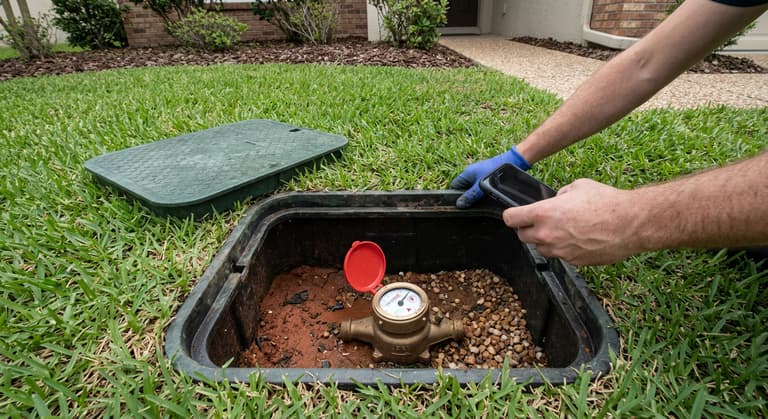
- The meter does the first check by itself. EPA has it read before and after a two-hour period with nothing running, and any change at all counts.
- One valve halves the problem: closing the cold inlet on the water heater takes the hot lines out of play, a no-tools method from a Texas plumbing contractor.
- Sound is what pinpoints, and it has a floor: EPA puts the pressure difference needed for substantial audible sonic waves above 15 psi.
- Thermal imaging carries three limits EPA names outright, including that leaks may be masked by ground water.
- No owner cores or chips concrete. PTI lists coring and drilling after construction among the mechanisms ending in tendon failure.
Shut every fixture, watch the water meter for two hours, and if the dial creeps, water is escaping below the house. That two hour EPA check is step 1 of 5 and it does most of the work to find a water leak under a slab. The other four narrow the zone from a house to a room.
None of it means opening concrete. An owner's job is evidence: that water is moving, which line owns it, and where to mark the floor.
Step 1: how to detect a water leak under a slab with the meter alone
EPA puts it in two sentences: "Check your water meter before and after a two-hour period when no water is being used. If the meter changes at all, you probably have a leak." Not much movement. Any.
Most meters carry a low flow indicator that reacts long before the odometer does. Portland Water Bureau describes it generically as "a red or blue triangular-shaped dial or a blue snowflake-shaped dial". If it sits still, that utility advises noting where the hand sits, waiting several hours using no water indoors or out, then reading again.
The sensitivity is real, though published figures measure different things. Neptune's T-10 sheet puts AWWA standard low flow at 95 percent accuracy at 1/8 US gpm for a 5/8 inch meter. The Sensus iPERL sheet says its 5/8 inch meter "Starts registering flow as low as 0.03 gpm", the smallest flow it counts at all rather than an accuracy-rated one.
- Close everything. Faucets, ice maker, irrigation controller. A running toilet flapper imitates a slab leak all day.
- Photograph the meter face, digits and sweep hand, with the phone timestamp.
- Walk away for two hours, then photograph it again and compare. Nobody flushes: small losses need time to show.
- Read the bill for pattern. EPA says a household of four running over 12,000 gallons through a winter billing month may have serious leaks.
A dial that moves with the house shut down is enough to act on. Dial (800) 555-0142 and describe exactly that: the call is free, and the licensed plumber answering does slab work daily.
Step 2: hot line or cold line, decided at one valve
A moving meter says water is escaping, not which buried line is doing it. A Texas plumbing contractor publishes the no-tools version: close the cold water supply valve on the heater, top right of the tank as you face it, then read the meter again.
That source lists two prerequisites mattering more than the valve: every sink, shower and tub faucet fully closed and not dripping, any recirculation pump unplugged. Reading the result is ordinary trade practice rather than that contractor's claim: with the heater isolated, a dial still moving points at the cold half, a dial that stops at the hot.
If the dial stops with that valve closed, the hot water line leak page is next: symptoms and repair options both narrow once the hot side is confirmed.
Step 3: sound is what actually pinpoints it
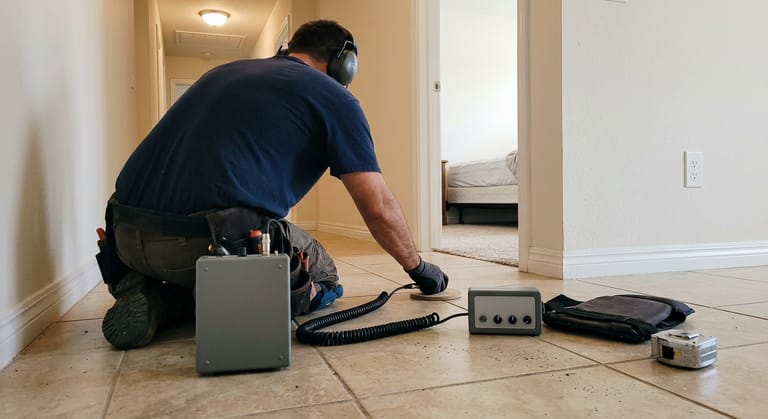
Two hours at the meter proves loss and locates nothing. To locate the leak a plumber listens for water escaping under the slab, because pressure through a small opening makes two distinct noises.
EPA describes both. The shockwave at the opening runs 500 to 800 Hz through both pipe and water, reaching fixtures hundreds of feet away. The second, 20 to 250 Hz, comes from the stream hitting bedding material and washing out a cavity. That lower band travels through soil, dies away quickly, and is the band that pinpoints: "Geophones are best used for detecting leak sounds that are propagated largely through the ground," EPA says.
Sound has a floor. EPA puts the differential pressure needed for substantial audible sonic waves above 15 psi, so a low pressure line can be silent, and larger leaks are not always louder than small new ones.
| Pipe material | Noise travel | Consequence |
|---|---|---|
| Copper tubing | 600 to 1,000 ft | Acoustics work well |
| Galvanized steel | 800 to 1,200 ft | Carries furthest |
| Poly plastic tubing | 50 to 100 ft | A tenth as far; gas instead |
EPA wrote that for street mains; a house slab is shorter and noisier.
Listening is where an owner's part ends: nothing gets drilled to hear better. Dial (800) 555-0142 with the meter result in hand, free, and a licensed plumber carries it from there.
Step 4: thermal imaging, and the three limits EPA names
Cameras get sold as the answer; they are a shortcut at best. EPA is neutral: "Thermal detection devices look for the temperature differences in the surrounding ground caused by saturation due to the leaked water." On a hot line that contrast shows through tile; on a cold line it can be nothing.
EPA lists three weaknesses. The temperature swing it depends on may be slight. It says nothing about how big the leak is. And groundwater can hide the target.
Good for
- Confirming a warm patch somebody already felt
- Documenting the wet zone for the insurer
Useless for
- How big the loss is, per EPA's weakness list
- A cold line with no contrast to show
Warmth is one reliable symptom among several: read the seven signs ranked by how often they hold up before acting on a hot tile.
Step 5: moisture readings and the file you hand the plumber
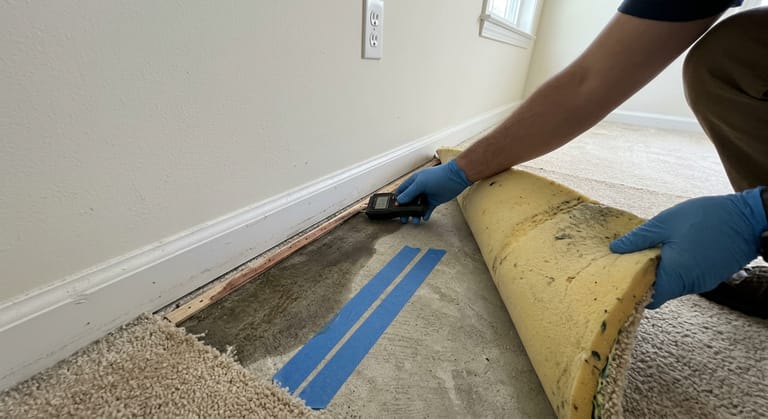
The last owner step is documentation, and it beats most gadgets. Walk the floor barefoot for warm spots, run a hand along baseboards and kickplates, check where carpet meets tack strip. A hardware store moisture meter will not show where the pipe runs, but it maps the edge of a damp zone the eye misses. Mark that edge and get it dried: EPA puts the deadline for drying water-damaged goods at two days, past which mold becomes likely.
- Both meter photographs, with times and the length of the shutdown.
- The heater valve result: did the dial stop, slow, or carry on unchanged.
- A floor sketch marking warm spots, damp readings and lifting flooring.
- The last three bills, so the curve shows when it bent.
- Pipe material and house age, plus whether the slab is post-tensioned.
That file turns a long diagnostic visit into a short one, and short visits cost less. Reading it out to a licensed plumber costs nothing.
Put it to someone who opens floors for a living
Call (800) 555-0142Costs nothing to dial. A licensed plumber who does slab work answers, not a scripted call center.Licensed partners who locate and repair slab leaks- Plumbers who locate the leak before anyone breaks concrete
- Someone picks up at 3 a.m. too
- No charge to call, no obligation to book
- Your quote comes from the plumber, with nothing added by us
Slab leak detection equipment, and why none of it belongs in a cart
Leak detection under a concrete slab splits into families of gear, and what matters is knowing what each is bad at. Under slab water leak detection equipment is professional kit priced for utilities; the best slab leak detection equipment is whichever suits the pipe and the pressure, decided after listening rather than before.
| Family | How it works | EPA 2010 capital cost |
|---|---|---|
| Listening rods | Amplify pipe-borne noise at fixtures and valves | $15 to $25 |
| Geophone | Reads ground-borne noise; the pinpointing instrument | $350 to $400 |
| Noise correlator | Sensors either side; arrival times give distance, and it handles PVC | $20,000 to $32,000 |
| Tracer gas | Injects an inert mixture, then sniffs for it above ground | $16,000 to $18,000 |
EPA's note against the correlator row reads "Not unusual for the accuracy of leak locate to be better than 1m/100 meters", roughly one meter of error over a hundred meters of pipe. Tracer gas earns its place where acoustics struggle: EPA lists independence from pipe material, water pressure and the shape of the opening among its strengths. It injects "typically a 5% hydrogen-nitrogen mixture" and sniffs above the line. EPA is candid about the catch, that gas methods detect a fault better than they locate it, and wants the local drinking water regulatory agency consulted first.
No consumer slab leak detector tool replaces any of that, and useful spending stops at a moisture meter.
Plumbing slab leak detection, in one sequence
Together the five steps find a water leak under a slab down to a room, as far as an owner should push it. Plumbing slab leak detection then runs in a fixed order, and skipping ahead wastes money:
- Confirm loss with the two hour meter test.
- Split hot from cold at the heater inlet valve.
- Isolate the run at accessible shutoff valves.
- Listen with rods, then a geophone or correlator.
- Confirm by a second method before concrete is marked.
How to find a plumbing leak in a slab when the meter will not move
A still dial does not clear the concrete. Drain and sewer lines beneath a house are not pressurized, so a broken one loses nothing the meter counts, and the evidence changes: slow drains at several fixtures, sewer odor near a floor, a damp patch with no warmth.
Those go to a camera, not a listening rod. HomeGuide prices running a camera down a sewer line at $125 to $500, and notes some pros waive it if the repair follows. What the camera finds decides the method, the subject of drain and sewer repair beneath a slab.
Two patterns also fake a still dial: an intermittent fault that opens only under peak pressure, clean at 2 p.m. and dirty at 6 a.m., and a break on the utility side of the meter, not the homeowner's to chase.
Still dial, wet floor, no explanation: put it to somebody who tests for a living, free of charge on this line.
Where the do-it-yourself part stops, without exception
Outdoors the rule is as firm. The Common Ground Alliance runs 811 as a free nationwide call-before-digging line and wants a few working days' notice, with locators marking positions in paint or flags. CGA warns that some utilities sit just inches below the surface, and puts yearly damage to all buried utilities at about $30 billion in repairs and societal impacts.
Where water has reached anything electrical, the Electrical Safety Foundation allows no discretion: gear that has been under water can still be live, so it goes untouched. Water rising through the floor now is a different page, what to do in the first twenty minutes.
Any line crossed, the next move is a phone call, not a tool. Check credentials first: how to vet a slab leak plumber and verify the license.
What professional detection costs before any repair
Detection is priced apart from repair by most shops, and the ranges cluster: HomeAdvisor, updated June 2026, gives $150 to $400 and suggests planning on $280; Fixr, last updated May 2025, gives $100 to $400.
USGS works an example of a supply line shedding six gallons an hour: 144 gallons a day, which is what a detection fee weighs against. Method by method pricing sits on the slab leak repair cost breakdown.
With the evidence in hand, dial (800) 555-0142 and read it out. The line costs nothing to call and is staffed through the small hours as well as the working day, and whoever picks up is an unaffiliated plumber licensed where you live. What sits behind this page publishes and nothing more; the fee for the introduction comes off the plumber's side, never your invoice.