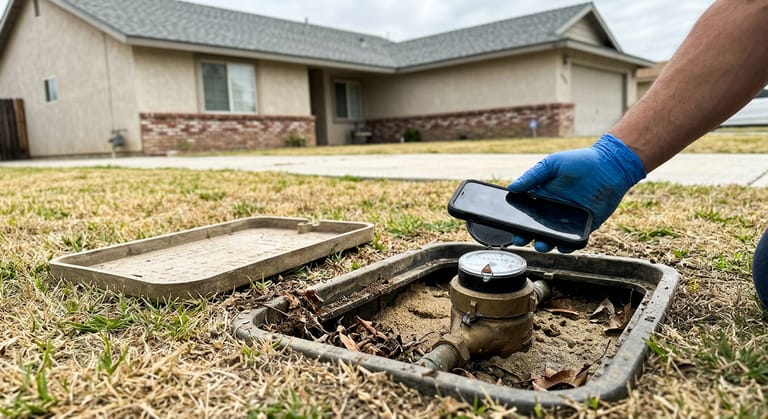
A slab leak is a pressurized water line losing water under the concrete slab a house sits on. The meter settles the first question: shut every fixture, read it, wait two hours, read again, and any movement means water is leaving the system. Repair runs $630 to $4,400 nationally, HomeAdvisor reported in June 2026.
Where the leak hides under a concrete slab
A slab-on-grade house rests on the ground itself: no crawl space, no basement. Supply lines run inside or beneath the concrete, so a plumbing leak in slab construction has nowhere to announce itself. Water follows the trench, soaks the fill, and surfaces feet from the break or not at all.
That is ordinary construction. Of 1,005,000 new single-family houses completed in 2025, the Census Bureau counted 754,000, or 75 percent, in its catch-all category "slab or other types". Across the South the share was 88 percent.
Two forces do most of the breaking. Clay that swells and shrinks with moisture loads the pipe from outside: NRCS soil data marks linear extensibility above 3 percent as the level at which ground movement starts wrecking structures, while adding that such data is no substitute for a geotechnical report on one lot. Aggressive water works from inside, thinning copper until a pinhole opens.
Cause by cause, copper against PEX: what a leak under the slab actually is.
Two readings, two hours apart
EPA's instruction is blunt: take a reading, spend 120 minutes drawing nothing anywhere in the house, read the register again, and let the smallest change stand as water escaping. That is the test a plumber asks for first.
- Close everything that draws water. Taps, toilets, washer, ice maker, irrigation timer, pool fill.
- Open the meter box and photograph the face. Curb or front walk, under a plastic or iron lid.
- Come back two hours later and photograph it again. The small dial beats the odometer to it: the bureau's description covers two shapes, a triangle colored red on some registers and blue on others, and a snowflake that is always blue, either of them turned only slowly by a drip.
Movement with the house shut down proves loss, not location. A still dial is no clearance either: that utility's next step is to note where the hand sits, use no water for several hours, then read again. Warm floor underfoot points at the hot side, and so do a hiss under quiet concrete, a damp baseboard in dry weather and a bill that climbed on its own.
Close the main valve if water is visible, then stop. Pinpointing takes acoustic gear, pressure isolation and thermal work, not a rented hammer. Dialing costs nothing, and the licensed plumber who answers does this weekly.
Symptom by symptom: seven signs plumbers rank first, how the spot gets located, what it looks like in photographs.
Put it to someone who opens floors for a living
Call (800) 555-0142Costs nothing to dial. A licensed plumber who does slab work answers, not a scripted call center.Licensed partners who locate and repair slab leaks- Plumbers who locate the leak before anyone breaks concrete
- Someone picks up at 3 a.m. too
- No charge to call, no obligation to book
- Your quote comes from the plumber, with nothing added by us
Fixing a slab leak
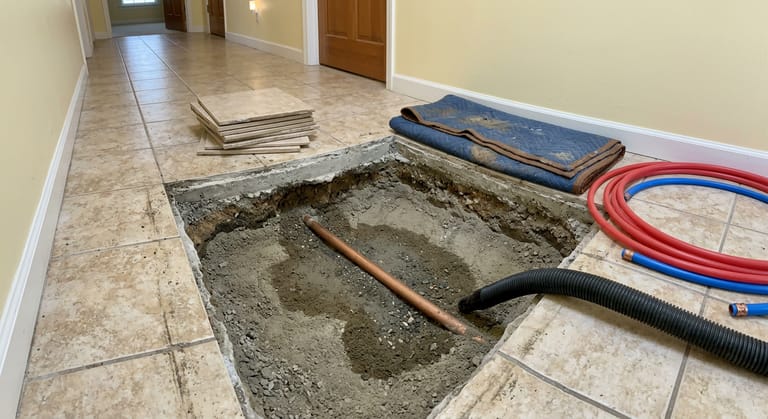
Four routes exist, and position decides which one is reasonable.
| Route | What happens | Where it fits |
|---|---|---|
| Spot repair | Concrete opened over the break, that length replaced | One failure, position known |
| Reroute | Buried run abandoned, new line overhead or in walls | Repeat failures, or a break under cabinets |
| Lining | Existing pipe lined from the inside | Several pinholes, floor staying shut |
| Tunneling | Access dug from outside, in under the foundation | Floor nobody wants opened |
HomeAdvisor put the national average at $2,280, inside a normal range of $630 to $4,400, on a page updated in June 2026. HomeGuide prices lining at $500 to $3,500 and digging into the foundation to replace damaged pipe at $700 to $5,000. Route and access move that figure far more than pipe does, which is why a quote follows the location instead of preceding it. Asking is free: (800) 555-0142 reaches a state-licensed plumber who quotes this work for a living, and no floor gets opened to produce it.
Compare before agreeing: the four repair methods, routes that avoid breaking concrete, what each one runs.
Is a slab leak an emergency?
Usually yes, though not the sirens kind. EPA reports that leaks in nine percent of American homes waste 50 gallons a day or more, and a broken supply line under concrete runs around the clock. EPA also asks that soaked material be dried out within two days at the outside, saying growth is unlikely where that window is met. That window separates a plumbing bill from a flooring bill. Which half an insurer picks up is set by the policy wording.
Two situations stop the reading and start a different call. Smell gas near the floor and the order is fixed: leave the building on foot, touch no switch and use no phone indoors, then call 911 and your own gas utility from outside. PHMSA is explicit that a telephone is not used in the area and nothing electrical is switched on or off. Where water has reached outlets, wiring or an appliance, ESFI's rule is that anything drowned may still be live and stays untouched, that nobody re-enters until the electric utility confirms the supply is dead, and that soaked equipment is checked over before it runs again.
Water standing on the floor already: how the opening twenty minutes go. Warm tile plus a water heater that never rests: a hot line losing water below.
Searching slab leak near me, and what this number reaches
No branch office stands behind the number on this page. Artistic Plumbing publishes about this failure and repairs none of them. The line puts a caller through to a plumbing business nobody here owns, licensed in the state that caller lives in. Nobody pays to dial it, and where a visit becomes work you agree to, that firm pays this desk a set introduction sum, and none of it reaches your invoice.
Regions fail for different reasons: swelling clay under Dallas and Fort Worth, pitted copper across Orange County, soil that corrodes buried metal around Oklahoma City. Past 180 mg/L of calcium carbonate, USGS grades water very hard, and its domestic-well sampling found hardness common through the east-central and western United States.
Ask for the license number before concrete is opened. Every state board publishes a lookup, and a plumber who does this daily reads it out without hesitating. Eight questions worth asking first: choosing the plumber who does slab work.
Put it to someone who opens floors for a living
Call (800) 555-0142Costs nothing to dial. A licensed plumber who does slab work answers, not a scripted call center.Licensed partners who locate and repair slab leaks- Plumbers who locate the leak before anyone breaks concrete
- Someone picks up at 3 a.m. too
- No charge to call, no obligation to book
- Your quote comes from the plumber, with nothing added by us