Leak Under a Concrete Slab, and the First 20 Minutes That Decide the Damage
The short version
- Close the main valve before anything else. The access rule the plumbing codes impose runs on valves, not on buried pipe: IPC 606.3 requires access to all full-open valves and shutoff valves.
- A 1/16 inch opening at 60 psi runs 822 gallons a day on a Kansas municipal leak chart, which is why a quiet drip below the floor is still an emergency.
- EPA sets the drying clock at 24 to 48 hours and says that in most cases mold will not grow when wet materials are dried inside that window.
- Gas smell is a different emergency: leave on foot, call 911 from outside, then your own gas utility, and touch no switch or phone indoors.
- HomeAdvisor's national figures put the normal repair range at $630-$4,400 with a $2,280 average, on a page updated June 19, 2026. Detection alone runs $150 to $400 there.
Shut the main valve first, because a leak under a concrete slab will not stop on its own. A 1/16 inch opening under 60 psi sheds 822 gallons a day on a leak chart out of Pratt, Kansas. Then read the meter, photograph the wet floor, and keep clear of anything electrical standing in water.
The first 20 minutes, in order
Six moves, in the order they matter.
- Close the main shutoff. Look at the meter box, then where the service line enters the wall. The access rule the codes impose runs on valves rather than on buried pipe: IPC 606.3 requires access to all full-open valves and shutoff valves. If nothing there turns, say so on the call.
- Read the meter with the house quiet. EPA's WaterSense program states the test: read the register, sit out two hours in which not a tap runs, read it a second time, and let any difference stand as proof water is escaping. Describing meters generally, the Portland Water Bureau sorts leak detection dials into two families, triangles on some meters and blue snowflakes on others; whichever yours carries, seeing it turn is the faster tell.
- Treat wet wiring as the bigger emergency. The Electrical Safety Foundation is blunt: "Never touch electrical equipment that has been submerged as it may still be energized." Its flood guidance adds no breaker with wet hands, and no flooded room entered until the electric utility has confirmed power off.
- Photograph before anything moves. The dark carpet edge, the warm strip on tile, the meter face, the clock.
- Put air on the wet material. EPA's mold guidance sets a drying window rather than a countdown: dry wet areas and items within 24 to 48 hours and in most cases mold will not grow.
- Leave the concrete shut. The Post-Tensioning Institute counts a hole cut into a cured slab as one route to a wrecked tensioned floor, so no bit goes in until the steel has been mapped and an engineer has ruled on it.
That is the homeowner list. Pinpointing the line is licensed work with instruments behind it, and the call that starts it costs nothing at three in the morning.
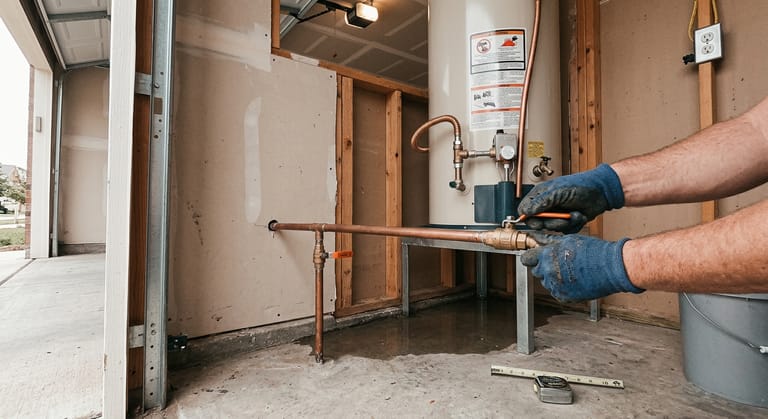
How to detect a water leak under a concrete slab
Two rounds of elimination are free. With every fixture closed and the meter still moving, water is escaping a pressurized line, not a drain. A working Texas plumber, not an agency, sets out the second round: close the valve on the cold inlet feeding the heater, which that firm places at the top right of the tank as you face it. A register that goes still at that point reads to plumbers as a hot line running.
Past that, leak detection under slab conditions is a listening problem. EPA's water loss guidance, written for utilities surveying buried mains rather than house lines, describes two noises: a shockwave normally in the 500 to 800 Hz range, carried by the pipe and the water, and a 20 to 250 Hz noise from water striking the pipe bedding, which travels through the ground and pins the spot down. Loudness lies, EPA adds: larger leaks can run quieter than newer, smaller ones.
What does a slab leak look like
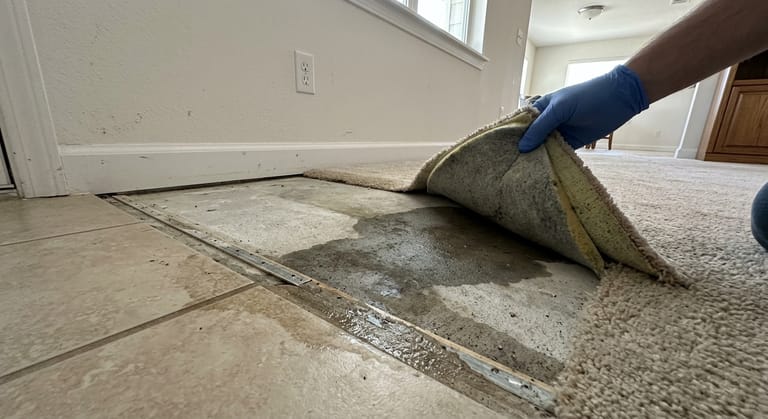
Rarely like a burst hose. Water travels sideways through fill and bedding, so what surfaces is seldom above the failure.
| What you see | What it usually means | First move |
|---|---|---|
| A warm strip across the floor | Hot line discharging below | Bare hand on the tile at night |
| Carpet dark at a wall in dry weather | Water tracking on top of the concrete | Lift a corner and photograph it |
| Running water heard, every tap shut | Pressurized line still feeding it | Meter read twice, two hours apart |
| A bill up with no habit change | Loss running for weeks | Compare a cold month with last year |
| One grout line darker than the rest | Moisture rising through the floor | Moisture reading before tile comes up |
The full set, ranked by how much weight plumbers give each sign, sorts out what matters, and photographs of these failures do the rest. Two matches, or one plus a moving meter, is where looking stops and a free call to a licensed plumber starts.
Burst pipe under a concrete floor
A burst pipe under concrete floor slabs behaves nothing like a split line in a wall: no bang, no spray to point at. USGS sizes the loss: ten minutes per gallon works out to 144 gallons across a day and 52,560 across a year. A pipe burst under slab fill sends that water into the ground, up through the concrete, and out at the lowest point in your flooring.
A pipe burst under foundation level also changes what the ground does: saturated fill beneath one corner is not the bearing condition the rest of the floor sees. That is a call for a licensed plumber and, where movement shows, an engineer.
Put it to someone who opens floors for a living
Call (800) 555-0142Costs nothing to dial. A licensed plumber who does slab work answers, not a scripted call center.Licensed partners who locate and repair slab leaks- Plumbers who locate the leak before anyone breaks concrete
- Someone picks up at 3 a.m. too
- No charge to call, no obligation to book
- Your quote comes from the plumber, with nothing added by us
What a gas smell near the slab changes
Water on the garage floor or along an outside wall
Wet concrete is not proof of a failed supply line. A garage puddle can trace to the water heater standing there or to air handler condensate, sorted on water on the garage floor; water at an outside wall that only shows after rain is usually drainage, sorted on groundwater or a failed line. A loss that runs in dry weather and moves the meter is plumbing. Both checks are yours; the call that reads them costs nothing.
What a homeowners policy does with water escaping under a slab
Neither policy form read for this section defines the trade term. A leak under a concrete slab reaches a policy as water getting out of the pipework, and NAIC describes homeowners coverage as reaching a discharge that is "sudden and accidental". Accidental discharge from plumbing sits on the Insurance Information Institute's HO-3 peril list as well, beside a caution the same page carries: damage traced back to upkeep left undone stays outside the policy.
Who answers, and what happens after the call
This job sits between two trades, and the wrong first call wastes a day. It wants a plumber who locates before opening anything; how that differs from a detection outfit or a foundation contractor is on choosing a slab leak plumber.
Twenty minutes in, the next move is the phone. (800) 555-0142 answers at any hour, costs nothing, and puts on the line a plumber licensed in your state who spends the week under slabs like yours. Have the meter dial and the hour the damp showed up ready. A publication stands behind this page, never a plumbing outfit: booked work pays this desk a flat introduction fee out of the plumber's advertising, and your estimate never carries it.