How Slab Leaks Get Repaired, and What Each Route Costs
The short version
- Four routes reach the pipe: open the floor above it, reroute the line overhead, line the old pipe from inside, or tunnel to it from outside. The route decides the bill more than the pipe does.
- HomeAdvisor puts the normal national range at $630 to $4,400 with an average of $2,280, updated June 19, 2026. Texas contractors publishing their own menus land far above that on tunnel work.
- HomeGuide says the work usually runs 1 to 3 days, and several weeks where flooring or cabinets were wrecked and new material has to be ordered.
- Under the UPC, water piping has to be copper tube not less than Type L, since Type M is permitted only aboveground in a building or underground outside it, and joints beneath the concrete have to be brazed with wrought copper fittings.
- Post-tensioned concrete changes everything. Tendons get located before any coring, and cutting one is engineered work, never a same-day decision.
Four routes exist to repair a slab leak: break the slab over the pipe, reroute the line overhead, line the pipe from inside, or tunnel in from outside. HomeAdvisor puts the normal national range at $630 to $4,400, and the access route, not the pipe, sets most of that.
Nothing opens until the leak has an address
Concrete slab leak repair starts with a location, never with a jackhammer. The cheap version and the ruinous version differ mainly in how much concrete came out before anyone found the water, so the hour spent pinpointing is the hour that moves the number.
Two checks belong to the homeowner. EPA's version is short: log the register, hold every fixture shut for a couple of hours, then log it again; a second figure that differs at all is the leak announcing itself. The second is the meter's own leak detection dial, which Portland Water Bureau describes in two shapes according to the register, and which a drip turns only slowly.
After that the tools stop being household ones. Acoustic gear, thermal scanning and pressure isolation narrow a wet line to a spot on the floor, and the full pinpointing protocol sits on its own page, with what these leaks look like once the surface gives them away alongside it.
Waiting is expensive in water alone. USGS gives the arithmetic for a supply line losing a gallon each ten minutes: 144 gallons in a day, and 52,560 by the end of the year. Two hours at the meter is free, and so is the call that follows, which reaches a licensed plumber rather than a booking script.
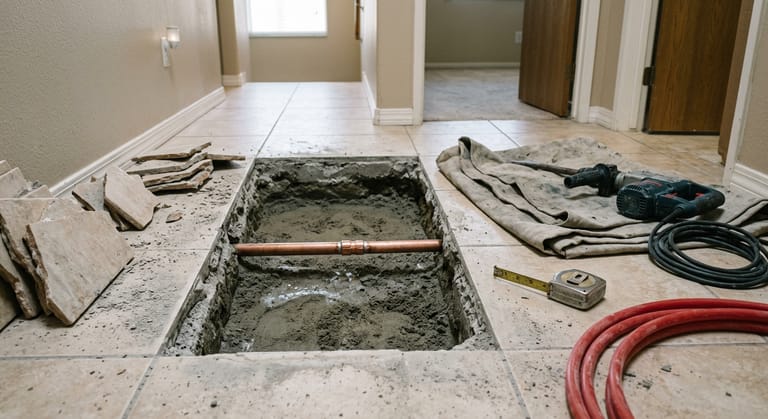
Route 1: open the slab above the pipe
The direct route cuts flooring and concrete over the failed section, replaces that section, and closes the hole. HomeGuide prices the access alone, breaking the slab or trenching to a badly damaged pipe, at $500 to $3,000, and lists pipe replacement separately at $200 to $2,000. One Dallas-Fort Worth firm quotes $7,000 to $9,000 for most residential direct repairs in its market, and qualifies that as one access point without fully accounting for concrete remediation.
It wins where the failure is one spot on an otherwise healthy line and the flooring above is cheap to reinstate.
Route 2: reroute the line overhead
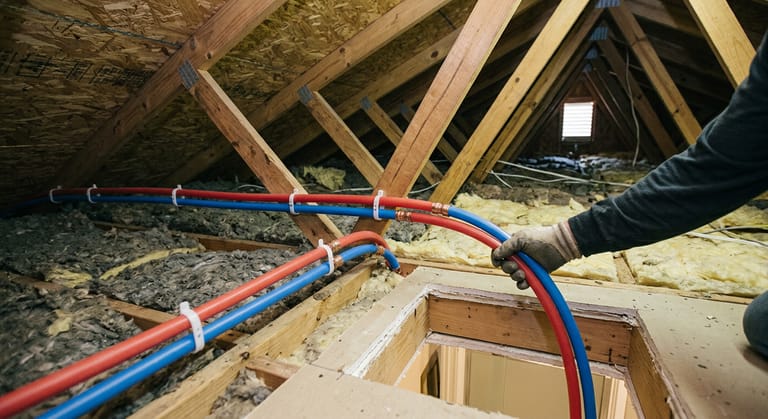
Abandoning the buried run and rebuilding it through the attic and walls is the standard answer where one line has failed twice, or where the leak sits under tile nobody wants to cut. HomeGuide puts rerouting at $3,900 to $7,500 on average and calls it complex and time consuming, though less invasive than digging into the foundation. A Dallas-Fort Worth firm bills by the drop instead: $1,600 to $1,800 per water line drop, and $8,000 to $9,000 for an average bathroom with five drops, counting two sink faucets, the hot and cold shower lines and the toilet.
Material rules shift once the pipe leaves the ground. UPC 604.3 requires copper tube of not less than Type L for water piping, and permits Type M only where the piping is aboveground in or on a building, or underground outside structures. Overhead pipe is aboveground; the same tube buried in the floor is not.
Budget the walls as well as the pipe. HomeGuide adds $300 to $1,500 or more to repipe jobs for repairing drywall cut to reach the plumbing. Choosing among the three routes is a separate exercise from pricing one, and rerouting, lining and tunneling get weighed against each other.
Route 3: line the old pipe from inside
Lining coats the inside of the existing run instead of removing it. HomeGuide prices a leak repaired by installing a pipe lining at $500 to $3,500, and cured in place lining at $90 to $250 per linear foot, noting the method is expensive but requires no digging. One Houston contractor prices minor epoxy or patch work at $500 to $1,500.
Route 4: tunnel to the pipe from outside
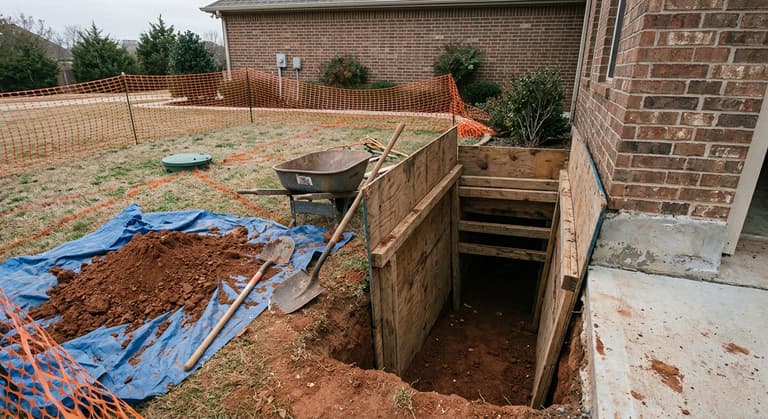
Tunneling reaches the failed section from the exterior, leaving the floor above untouched. Every verified per foot figure here comes from Texas, so read them as one state's market. A Bryan foundation contractor states the average price of under slab tunneling falls in the $200 to $500 per foot range, and that its own rate is $400 to $500 per foot. The same page works one example, a hall bathroom whose drain lines need roughly eight to ten feet of tunnel, and lands on $3,000 to $5,000 covering both the dig and the fill, quoted for its own corner of central Texas. Fixr, the only non regional source found, lists tunnels at $900 to $2,000 for 2025.
Whether either invoice reaches an insurer is a separate question, answered by the policy form rather than the plumber: what a homeowners policy pays toward a slab leak.
Drain and sewer failures beneath the floor are their own animal, diagnosed and priced differently, and under slab plumbing repair on the waste side covers camera work, tunnel access and who is licensed to touch it.
Put it to someone who opens floors for a living
Call (800) 555-0142Costs nothing to dial. A licensed plumber who does slab work answers, not a scripted call center.Licensed partners who locate and repair slab leaks- Plumbers who locate the leak before anyone breaks concrete
- Someone picks up at 3 a.m. too
- No charge to call, no obligation to book
- Your quote comes from the plumber, with nothing added by us
The four routes side by side
| Route | Where it fits | Published price, by source |
|---|---|---|
| Open the floor | One failure point, cheap flooring above | $500 to $3,000 access, plus $200 to $2,000 for the pipe (HomeGuide) |
| Reroute overhead | Repeat failures, tile or stone above the run | $3,900 to $7,500 average (HomeGuide) |
| Line from inside | Sound pipe, small perforations, no digging wanted | $90 to $250 per foot (HomeGuide) |
| Tunnel from outside | Floor must stay intact, leak far from an edge | $200 to $500 per foot, Texas (one contractor) |
Three of those rows come from one publisher and the fourth from one contractor, so read the table as four jobs priced separately, not as one market. Put the same job title to different publishers and the answers land multiples apart: HomeGuide puts a reroute at $3,900 to $7,500, HomeAdvisor's reroute row reads $600 to $4,000, and Fixr's 2025 row reads $4,000 to $15,000, which is also Fixr's figure for repiping a whole house.
None of those numbers is a quote for your house, and a figure tied to your floor arrives only after the location is known. How estimates get built and what inflates them is worth reading first, or call (800) 555-0142 and say what the meter did: a licensed plumber will name the routes your floor is a candidate for, at no charge, and nothing gets cut on the strength of a table.
How long the work takes
HomeGuide says plumbers usually repair a slab leak in 1 to 3 days depending on severity and method, and that the job stretches to several weeks where flooring or cabinets were damaged and new material has to be delivered. Fixr splits it finer: 1 to 3 hours of inspection labor, and 2 hours to 3 days of repair labor.
One clock runs independently of the plumbing. EPA gives damp material one to two days to come dry, and reports that mold rarely takes hold when that deadline is kept.
How to fix slab leaks yourself, and the line you do not cross
Real homeowner work exists here, and all of it happens before concrete is touched.
- Shut the main and confirm the meter stops. That turns an active loss into a scheduling problem.
- Run EPA's two hour meter check with every fixture closed, then watch the leak detection dial.
- Separate hot from cold. One Texas plumbing company describes closing the valve on the heater's cold inlet, which it locates at the top right of the tank as you face it, after confirming every faucet is off and unplugging any recirculation pump.
- Photograph the warm spot, the damp baseboard and the meter reading with a timestamp. That file is worth money later.
- Stop at the concrete. Nothing sold to a homeowner will repair a slab leak, and cutting blind into a floor that may be post-tensioned turns a plumbing bill into a structural one.
The second boundary gets crossed by accident: patching the visible crack. Sealing the surface hides the symptom while water keeps running underneath. A register still creeping with every tap shut is the cue to call the number printed here, dial reading first. That call costs nothing, ends without a booking unless you want one, and puts a licensed plumber on the line.
Slab leak solutions and what that phrase is selling
Searches for slab leak solutions land in two places. Half want the methods above. The other half are hunting a business: searching slab leak solutions llc near me returns unrelated firms of that name in several states.
Worth saying plainly: what you are reading is a publication. Nobody here carries a plumbing license or turns a wrench on a floor. Any contractor trading under a name that resembles the one at the top of this page belongs to somebody else entirely and has no tie to this desk, and the number reaches a plumber in independent practice, licensed for the state you are calling from.
Slab leak repair near me: what to confirm before the truck rolls
Two things separate a plumber who can repair a slab leak from one who will learn on your floor: a current license and locating gear that arrives before the hammer does.
A plumbing license is the first filter on any slab leak repair shortlist, and every state publishes its own register. Four registers below name the fields that matter.
- Texas runs a public license search through the state licensing datamart. A Master Plumber number starts with M, and TSBPE Enforcement fields complaint questions by phone.
- California's CSLB verification lets you check complaint disclosure as well as status, and C-36 is the plumbing classification to look for on the record.
- Oklahoma's CIB runs one licensee search covering plumbing, electrical and mechanical licensees plus building and home inspectors.
- Florida's DBPR search matters twice over. A certified contractor may contract anywhere in the state, while a registered one may contract only in the jurisdiction that issued the competency.
The second filter is audible on the phone: ask what finds the leak before anything opens, and whether the concrete is the same company's work or a second one's.
Who actually handles this work, and the questions worth asking goes deeper on sorting a leak detection outfit from a plumbing contractor from a foundation company.
What the paperwork has to say before concrete opens
Two states publish rules specific enough to use as a checklist anywhere. TSBPE administrative rules stop a company from advertising, offering or taking on plumbing work at all until a currently licensed Responsible Master Plumber has been signed on to stand behind it. The Board states that RMP's insurance floor separately: at least $300,000 of general commercial liability coverage, which is a regulatory minimum rather than a typical policy.
HomeGuide's buyer questions close the remaining gaps: whether debris and concrete disposal sits inside the estimate or arrives later as a fee, whether all labor and materials are included, whether a permit is required and who pulls it, and what other expenses to expect. A plumbing permit runs $30 to $500 by HomeGuide's national figure, often folded into the contractor's price already.
Before anyone agrees to repair a slab leak in your house, get four things written down: the access route, the exact point being opened, who restores the floor, and what happens if the pipe fails again nearby. Materials belong on that page too. UPC 609.3 wants copper run beneath a slab in unbroken lengths wherever that can be done, with any permitted joint brazed using wrought copper fittings, while IPC 305.1 and its residential twin keep metallic pipe off bare concrete unless it is cast iron, ductile iron or galvanized steel, and put the protective plastic sleeve at 8 mil or thicker. What is running under the floor and why it failed explains the rest.
Route decisions belong to whoever has stood on the floor. (800) 555-0142 answers around the clock, free, nothing booked unless you ask: say what the meter did and hear which of the four ways to repair a slab leak your floor will take.
Put it to someone who opens floors for a living
Call (800) 555-0142Costs nothing to dial. A licensed plumber who does slab work answers, not a scripted call center.Licensed partners who locate and repair slab leaks- Plumbers who locate the leak before anyone breaks concrete
- Someone picks up at 3 a.m. too
- No charge to call, no obligation to book
- Your quote comes from the plumber, with nothing added by us