Slab Leak Repair in Dallas and Fort Worth
The short version
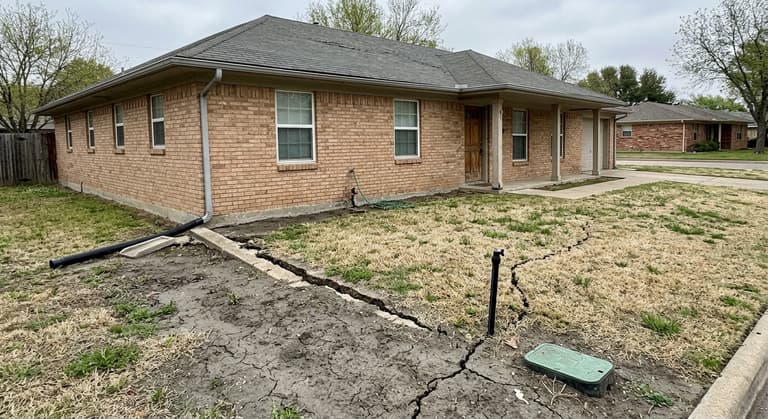
- The ground is the local variable. The NRCS Official Series Description for Houston Black records high shrink-swell potential for the series, and SSURGO maps 64,959 acres of one Houston Black unit in Dallas County.
- Fort Worth Water publishes total hardness of 108 to 150 ppm as calcium carbonate. Dallas Water Utilities publishes none at all, so no metro-wide number exists to quote.
- Permits are priced city by city and none of it is repair money: $181 per dwelling unit on the Dallas alterations table, $9.85 for the first fixture in Fort Worth, $85 for a Plano simple trade permit.
- Two Dallas area contractors price opening a slab roughly a factor of two apart, each figure its own company's. HomeAdvisor's national page, updated June 19, 2026, gave an average of $2,280 and a range of $630 to $4,400.
- On a post-tensioned floor nothing is drilled until the strands are located, and an opening that interrupts one needs a structural engineer's design.
Slab leak repair in Dallas is priced by access, not by the pipe. One Dallas contractor posts $3,700 flat for jackhammer access while a Dallas-Fort Worth firm posts $7,000 to $9,000 for a direct slab repair, and neither figure is a market rate. What strains the pipe underneath is clay.
The clay under this metro changes size, and buried pipe does not
Houston Black is a Vertisol, taxonomically Udic Haplusterts in the SSURGO record. The NRCS Official Series Description, revised 2017, records "high shrink-swell potential and cracks that are 1.3 to 10 cm (1/2 to 4 in) wide at 30 cm (12 in) depths during dry periods".
The Houston Black and Urban land complex on 0 to 4 percent slopes covers 64,959 acres in Dallas County and reads 55 percent Houston Black, 35 percent urban land, meaning pavement and structures. Tarrant County maps 10,754 acres of that complex plus 7,403 acres of Houston Black clay.
Slab leak repair in Dallas TX begins at the meter, not the floor
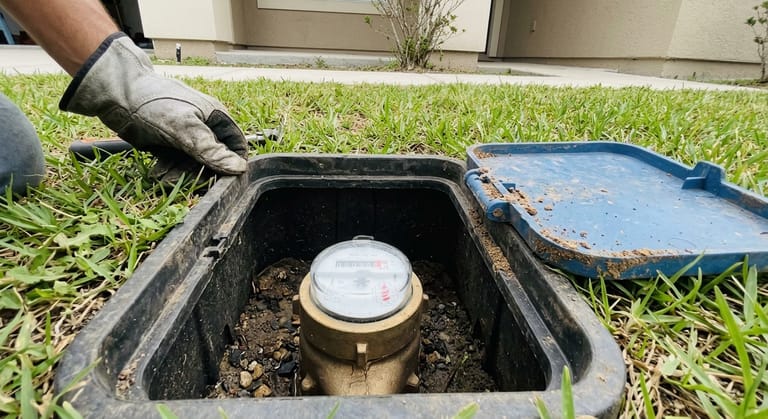
- Shut every fixture, then read the meter twice. EPA sets the gap at two quiet hours with nothing drawing water, and treats any movement whatsoever as probable evidence of a leak.
- Find the low-flow indicator. Portland Water Bureau calls it either a triangle, red or blue by make, or a snowflake, and has readers mark the hand position and look again hours later.
- Split hot from cold. A Texas plumbing contractor documents it: confirm every faucet is off, unplug any recirculation pump, then close the cold inlet valve entering the top of the heater.
That is the whole homeowner share. None of it marks the tile or narrows the leak to a spot: equipment work. Read the symptoms ranked by what each proves and what a slab leak is. If the dial moved, stop there: (800) 555-0142 carries no charge and reaches a plumber who does this in Dallas weekly.
Slab leak detection in Fort Worth, where the water gets published
Fort Worth Water publishes total hardness on its water quality page as 108 to 150 ppm as calcium carbonate. No sampling year is given, so read it as a published range, not your tap. USGS classifies 61 to 120 mg/L as moderately hard and 121 to 180 as hard, so that range sits astride the boundary.
Dallas has no equivalent. Hardness is not a regulated contaminant, so the word is absent from the Dallas Water Utilities 2025 quality report and its 2016, 2018 and 2020 archives, and the Dallas numbers circulating online sit on softener vendor pages citing no source.
Slab leak repair in Dallas costs whatever the access costs
| Route to the pipe | Posted figure | Whose number |
|---|---|---|
| Open the slab at the leak | $7,000 to $9,000 | Contractor A, a Dallas-Fort Worth firm, March 2026, one access point |
| Jackhammer and interior access | $3,700 flat | Contractor B, a Dallas company, 2025 flat-rate menu |
| Reroute overhead | $1,600 to $1,800 per drop, $5,000 to $7,000 per line | Contractor A; its five drop bathroom reroute is $8,000 to $9,000 |
| Tunnel from outside | $8,400 to $9,200 per 10 linear feet | Contractor A. Contractor B prices the first 10 feet at $4,200, then $250 a foot |
| National reference | Average $2,280, range $630 to $4,400 | HomeAdvisor, June 19, 2026 |
Stitching the lowest row to the highest invents a range nobody published, and only a locate settles which route applies: how prices break down by method. Ask which is being priced, in writing.
The leak bills you meanwhile: on USGS arithmetic a line shedding a gallon each 10 minutes runs to 144 gallons over 24 hours. Dallas Water Utilities, effective October 1, 2025, charges $4.81 per 1,000 gallons in its 4,001 to 10,000 gallon tier, and Fort Worth sells by the CCF, $2.28 for the first 6 and $5.37 above 24, effective January 1, 2026, a CCF being 748.1 gallons.
Put it to someone who opens floors for a living
Call (800) 555-0142Costs nothing to dial. A licensed plumber who does slab work answers, not a scripted call center.Licensed partners who locate and repair slab leaks- Plumbers who locate the leak before anyone breaks concrete
- Someone picks up at 3 a.m. too
- No charge to call, no obligation to book
- Your quote comes from the plumber, with nothing added by us
Permits and licenses: three fee schedules, one state board
Under 22 Texas Administrative Code 367.2, amended February 16, 2023, the Texas State Board of Plumbing Examiners adopted the 2018 Uniform Plumbing Code and the 2018 International Plumbing Code, cities may amend for local concerns, and inspection falls to a licensed Plumbing Inspector. Which code Dallas, Fort Worth, Arlington or Plano enforces was not verified here: ask the city.
Checking the person is quicker. Board rules require the first page of any proposal, invoice or contract to carry, in at least twelve point type, the name and license number of the Responsible Master Plumber of record and the phrase "regulated by the Texas State Board of Plumbing Examiners." Run that number through the Board's license search; the rest sits on hiring a slab leak plumber.
Slab leak repair in Plano TX and the newer end of the metro
Plano prices new construction apart from repair: a $75 plumbing certificate, plus $0.48 per square foot under roof and an $80 plan review fee.
County data stops short of Plano itself. ACS 2020-2024 estimates put the median year built for owner-occupied homes at 1978 in Dallas County and 1990 in Tarrant County; nothing comparable was gathered for Collin County, so no Plano median appears here.
Age still picks the route. Attic runs make an overhead reroute obvious in a newer house; under 1970s tile it often wins for the opposite reason, because opening concrete costs more than abandoning the line. That call needs a locate first: (800) 555-0142.
Post-tensioned slabs and the question asked before any drill
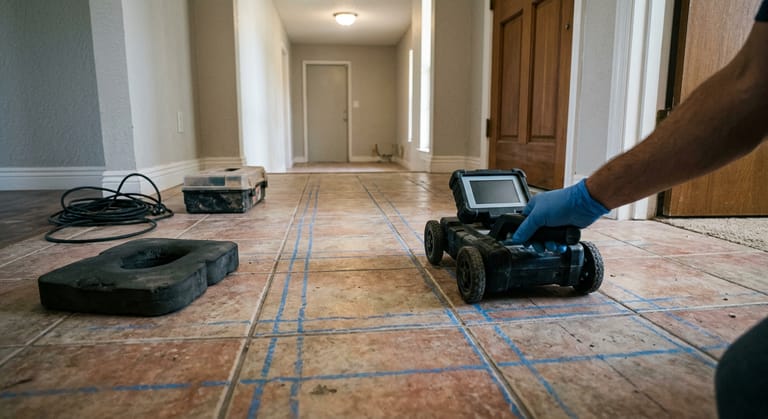
The Post-Tensioning Institute states that post-tensioned slabs-on-ground are a cost-efficient, high-performance solution for problems associated with ground-supported residential foundations on shrink-swell soils, and IBC 1808.6.2 sends the moments, shears and deflections for such a slab to WRI/CRSI or PTI DC 10.5. Nobody publishes how many houses here sit on one, so it is asked, not assumed.
What the 2021 and 2022 freezes did, and did not, change
NWS Fort Worth and Dallas recorded minus 2 F at DFW on February 16, 2021, and 139 consecutive hours from 5 pm on February 13 to noon on February 19, a tie for fifth place for most consecutive hours below freezing. NOAA daily summaries put the December 2022 front at 11 F on December 22 and 23. Hard weeks, not records, and neither changed what fails under a slab, which runs on pressure, ground movement and pipe age. Freeze exposure lives on exterior runs: IPC 305.4, titled Freezing, puts exterior water supply piping at least 6 inches below the frost line and 12 inches below grade, both minimums.
Where the homeowner part ends
The homeowner part ends at the concrete. Not yours at any level of confidence: pinpointing the line under it, opening or coring the slab, anything on a floor that might be post-tensioned. Clay leads here and not everywhere, so compare the corrosive ground around Oklahoma City and copper corrosion in Orange County, where metal fails before the ground does.
So dial (800) 555-0142 once the meter has told you something. The conversation is billed to nobody, and whoever picks up holds a Texas license and spends the working week under North Texas floors. What sits behind this page is a publication with a telephone number, never a contracting outfit: no trade license, no truck, no crew. Booked work settles a flat introduction fee, owed by the plumbing company rather than added anywhere, which is why the estimate you sign reads the same either way.