Slab Leak Repair in Orange County Starts With the Water
The short version
- The local record here is metal and water chemistry. Anaheim reported total hardness of 318 ppm in its groundwater average for 2024, 19 grains per gallon, on a row whose detections ran 135-431 ppm.
- Irvine Ranch Water District uses chloramine and states it is not aware of any established relationship between its treatment and pinhole leaks. Three districts, two of them county agencies, beat that allegation on appeal in 2018.
- The district's own list of documented pitting causes includes pipe buried or in contact with concrete, which is where a slab line lives.
- The median owner occupied home was built in 1975 per ACS B25037, and 94,310 owner occupied units are single unit attached per B25032. Attached is a structure type, not condo ownership, so the recorded declaration is what decides who pays.
- Permit money is separate from repair money: Anaheim prices the repipe line at $110 against a $188 minimum permit fee, Santa Ana charges $56.64 per 100 feet plus a 65 percent plan check, Irvine bills standalone work by the hour.
Slab leak repair in Orange County usually means copper: the median owner occupied home dates to 1975 (ACS B25037), inside the copper era HUD describes. A pinhole in that copper is what the local water district publishes about.
Partner plumbers keep one order: meter, hot against cold, locate, then concrete. Dialing (800) 555-0142 costs nothing, and the plumber who answers is licensed in California.
The water is hard, and the disinfectant is chloramine
Anaheim's 2025 Water Quality Report, on 2024 sampling, averages 318 ppm as calcium carbonate in groundwater, 19 grains per gallon, on a row whose detections span 135-431 ppm.
| Anaheim 2025 report, 2024 data | ppm as CaCO3 | Grains per gallon |
|---|---|---|
| Groundwater average | 318 | 19 |
| Lenain plant average | 288 | 17 |
| Imported MWD water, Anaheim's measurement | 271 | 16 |
One city system; no countywide figure is published. On disinfectant, Irvine Ranch Water District "uses chloramine in its drinking water to maintain a disinfection residual in the distribution system". Metropolitan's Diemer plant in Yorba Linda treats the imported share.
Copper pinholes, and the case that was lost
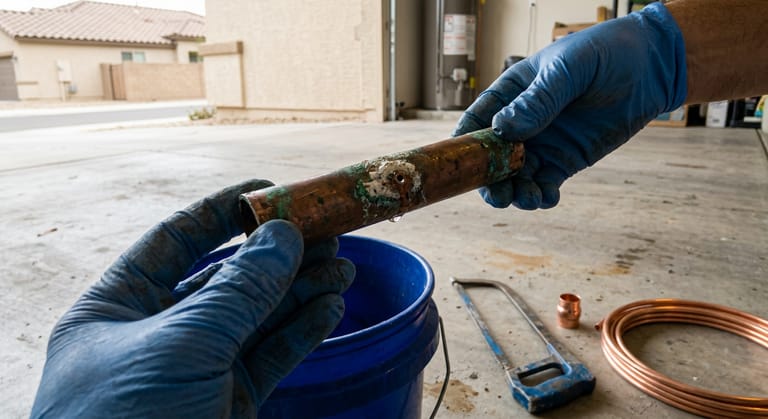
IRWD publishes that it "is not aware of any established relationship between our water disinfection and treatment process and pinhole leaks". The list printed beside that denial matters more.
Citing industry studies and court cases, the district documents many causes of copper pitting, including improper installation (flux, solder, mismatched pipe or size), faulty electrical grounding, galvanic corrosion between dissimilar metals, and pipe buried or in contact with concrete. An open list, not a closed count, and the last item describes a slab line.
AWWA's 2021 Water Science review counts roughly 750,000 pinhole leaks a year nationwide, adding "but we do not really know why".
A 1975 median home, and 94,310 attached ones
ACS 2019-2023 puts the median year built at 1975 for owner occupied units here, and counts 94,310 of them as single unit attached. A structure type, not an ownership form, but in a common interest development it is where the bill gets argued.
Pull the declaration, photograph the wet floor, notify the board in writing, and let a licensed plumber locate the leak while ownership is argued.
Reroute, repipe, or open the slab
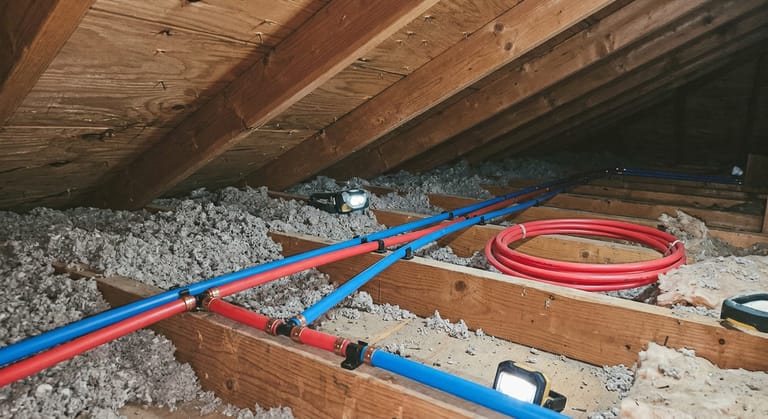
Slab leak repair in Orange County comes down to three routes once the spot is marked: reroute the buried run overhead or through walls, repipe when one pinhole follows another, or open the concrete and reach the failure in place.
A reroute wins when
- The failure sits under stone tile or built-in cabinets
- Walls or attic offer a path for new pipe
Opening the slab wins when
- One defect sits in otherwise sound pipe
- No wall or attic route exists
Published reroute prices disagree by multiples, none measured here: HomeGuide $3,900 to $7,500 in October 2025, HomeAdvisor $600 to $4,000 in June 2026, Fixr $4,000 to $15,000 in May 2025 on a row equal to its whole house replacement. Compare what the cost sources count with a repair that skips the jackhammer. Which route fits is a locate-and-quote question, and hearing the plan on (800) 555-0142 is free.
What Anaheim, Santa Ana and Irvine charge for the permit
Permit money goes to the city from the permit holder, never into the repair price, and changes one town over.
| City and form | Lines that touch this work | What the form adds |
|---|---|---|
| Anaheim, form B714, AUG 2026 | Water Distribution (Repipe) $110; drainage and vent repair $64; per fixture $49 | Minimum permit fee $188; supplemental permit $60 |
| Santa Ana, form APP-04, dated 03-11-2026 | Repipe and water service piping $56.64 per 100 feet; drain or vent work $56.64 | Issuance and general plan surcharge $98.16; plan check adds 65 percent of the subtotal |
| Irvine, Schedule II, effective August 15, 2026 | No per fixture table; standalone work billed hourly | Residential issuance $31.88; plan check $207.56 an hour; inspection $199.19 an hour; a 10 percent automation fee, residential remodels excepted |
Check the C-36 before concrete opens
16 CCR 832.36 carries the classification: a C-36 plumbing contractor "provides a means for a supply of safe water, ample in volume and of suitable temperatures", one of its six inclusions starting at the owner's side of the utility meter.
Checking one is free: the Contractors State License Board search takes a license number or business name and shows complaint disclosure with the record. CSLB also states that California home improvement work above $500 requires a written contract. Before booking, walk the questions to ask a slab leak plumber.
Slab leak detection in Anaheim, and the first hour on site
Slab leak detection around Orange County runs in order, and this part is yours.
- Close every fixture and appliance that draws water, then note the reading and where the low flow dial sits. Portland Water Bureau names two patterns for it, triangular and snowflake.
- Take a second reading 120 minutes on, nothing used in between. EPA treats any change at all as a probable leak; a dial already turning says it sooner. Still nothing, and the suspicion holds? Portland's slower variant leaves the hand marked for several hours.
- To split hot from cold, shut the valve on the heater's cold inlet with every faucet off; the inlets are marked, and a Texas contractor puts the cold one at the top right as you face the tank.
- Photograph the meter face, the warm patch and any wet baseboard, then stop.
Location is the partner's part: acoustic listening on a pressurized line, tracer gas where sound fails, thermal scanning of a warm floor. A meter that stops when that valve closes reads as a loss on the hot side under the slab. Two matching signs plumbers check first are reason enough to dial (800) 555-0142.
If you smell gas near a slab
Gas leak detection in Orange County is no homeowner check: it belongs to 911 and the gas utility.
The clocks California puts on a claim
What a policy pays turns on its wording and an adjuster's finding; timing is what the state fixes. Under 10 CCR 2695.5(e) an insurer has fifteen calendar days from notice of claim to acknowledge it, provide forms and instructions and begin investigating, unless the notice is one of legal action or payment arrives inside those days. Under 10 CCR 2695.7(b) it has forty calendar days after proof of claim to accept or deny, then written notice every thirty days if it needs longer.
The California Department of Insurance turns the duty around: policies "may not cover ensuing damage to your property if you have not taken reasonable steps to secure the property from subsequent damage". Its guidance also asks that wet areas be dried, delay growing mold. Shut the valve, dry, photograph. Ground changes the story elsewhere: compare Dallas Fort Worth and Oklahoma City and Tulsa.
Dial still creeping with every tap shut? Stop reading. (800) 555-0142 costs nothing at any hour, and whoever picks up holds a California license and pinpoints slab leaks for a living. Behind this page is a publisher, not a licensed contractor. A booked repair carries a set introduction charge, payable by the plumbing firm, and your estimate stays the plumber's own.