Slab Leak Repair in OKC, and the Soil Wrapped Around the Pipe
The short version
- The soil survey of Oklahoma County lists high corrosivity to steel among the management concerns of both general map units covering the western half of the county, printed alongside high shrink-swell, not instead of it.
- Code answers from the pipe's side: IPC 305.1 keeps metallic piping other than cast iron, ductile iron and galvanized steel out of contact with concrete and corrosive soil, behind plastic sheathing of at least 8 mil.
- The Copper Development Association lists aggressive soil among six causes of copper corrosion, while stating that with rare exception natural soils do not attack copper. Its warning is about backfill: cinders, not native clay.
- Owner occupied homes in both Oklahoma County and Tulsa County carry a median year built of 1980, so half of each predates it. HUD dates galvanized steel before the war, copper after it, plastics from the 1970s.
- Tulsa runs two water systems under one utility: 140 ppm average hardness at the A.B. Jewell plant against 89 ppm at Mohawk, because separate lakes feed them.
Slab leak repair in OKC answers to 2 forces, and only one gets discussed. The soil survey of Oklahoma County rates this ground high in corrosivity to steel as well as high in shrink-swell, so buried metal is attacked from outside while the clay moves around it.
That is a different failure from a pipe sheared by moving ground, and it is why code puts a plastic skin between metal and what touches it.
The ground here is rated corrosive, not only expansive
The NRCS survey of Oklahoma County puts the western half in the Central Rolling Red Prairies, carrying the Kirkland and Renfrow clays: Renfrow weathered from clayey shale of Permian age, Kirkland a clayey mantle over shale of the same age.
Both general map units covering that half carry the same warning, and for urban development the survey rates their soils poorly suited, listing high shrink-swell potential, very slow permeability, high corrosivity to steel and erosion hazard among its management concerns.
Kirkland map units are separately rated "Severe: shrink-swell" for dwellings, so ground movement is real here. It is not the only thing the survey says about a buried line.
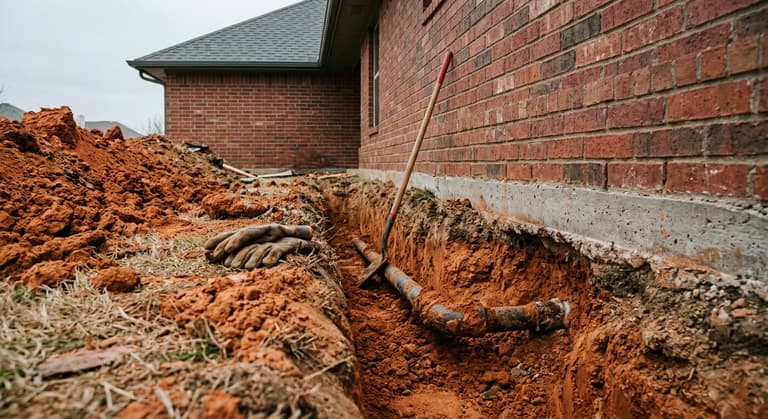
The sleeve, and the 12 inches of clean fill under it
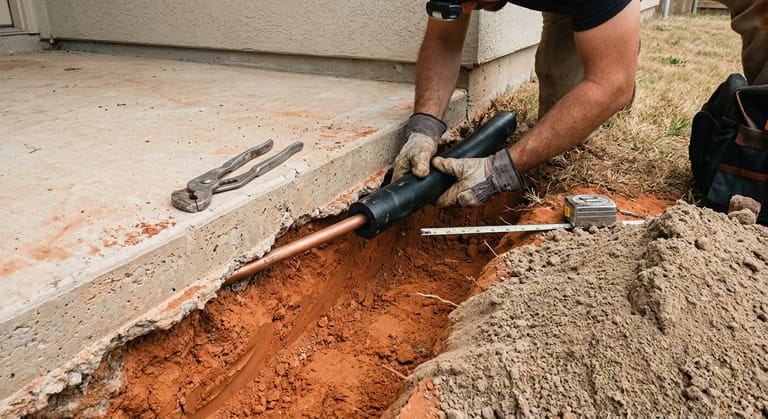
Code handles corrosive ground from the pipe's side. Under IPC 305.1, metal pipe of any kind except cast iron, ductile iron and galvanized steel is kept off bare concrete, masonry and corrosive soil. Whatever sleeve holds it clear must be plastic, 0.008 inch or thicker, and loose enough for the pipe to shift within it where the run crosses concrete.
The Copper Development Association is blunter about which soil is the problem. Aggressive soil conditions is one of six causes of copper corrosion it lists, beside hard well water, soft acidic water, excessive velocity, poor workmanship and aggressive flux. Then it narrows the case: with rare exception natural soils do not attack copper, but pipe laid in cinders is attacked by acid formed when sulfur compounds meet water. Hence its backfill rule, 12 inches of tamped clean earth carrying no cinders or stones.
Age narrows the guess. ACS 2020-2024 estimates place the median construction year for owner occupied housing at 1980 in both Oklahoma County and Tulsa County, so half of each stock predates it. HUD dates galvanized steel before the war, copper to the post-war decades and plastics from the 1970s: metal under a slab is likelier at an older address, never certain at a newer one.
Slab leak detection in OKC does not start with concrete
A slab leak detection call in Oklahoma City opens at the meter, and the first move is the homeowner's. EPA's instruction is short: take the reading, leave the house dry for 120 minutes, take it again, and let any difference between the two figures answer the question.
The bill is the second signal. Oklahoma City charges in four marginal blocks under its November 2025 rates, from $4.18 per 1,000 gallons for the first 2,000 up to $11.08 above 25,000, plus $22.02 a month for a 5/8 inch meter. EPA adds a threshold of its own: four people burning through more than 12,000 gallons in a cold month may be feeding a serious leak.
Pinpointing that line is equipment work, and none of it begins with a hammer. Symptoms in the order plumbers rank them sit on the signs of a slab leak. No fee on (800) 555-0142.
Slab leak detection in Tulsa turns on which plant fills the line
Tulsa is different ground and different water. Its prairie soils formed on shales, sandstone and limestone of Pennsylvanian age, not Permian shale, and NRCS rates Dennis "Very limited" for dwellings on a shrink-swell value of 1.00, top of a scale starting at 0.01.
The water splits too. Tulsa runs two systems under one utility, and its water FAQ says so plainly: "Lake Eucha and Spavinaw supply Mohawk. Lake Oologah supplies A.B. Jewell." That page puts A.B. Jewell at 8.2 grains per gallon, or 140 ppm, against 5.2 grains, or 89 ppm, at Mohawk: the USGS hard band at one plant, the band below at the other.
Resist the tempting conclusion. AWWA's 2021 review is candid about the limit: "despite decades of research, the pitting of copper pipes is poorly understood". No leak figure is published for either plant. Knowing which one fills the line helps; the listening belongs to a licensed plumber on (800) 555-0142, no charge.
Oklahoma City slab leak repair, and Tulsa's separate fee book
Neither city publishes a total; both build from a base plus items, Oklahoma City in Municipal Code Chapter 60, Title 42, Tulsa in Title 49, Chapter 8.
| Line item | Oklahoma City | Tulsa |
|---|---|---|
| Base fee | $84 residential alteration, up from $78.40 on July 1, 2026 | $81, first fixture or appliance included |
| Each further fixture | $7.00 per appliance or fixture on water and sewer | $3.31 |
| Water or sewer service | $25.50 each | $35.00 water service |
| Line extension | $100 per line, up from $91.50 on July 1, 2026 | Not priced in Title 49 |
| Extras | $50 reinspection, 50 cents per permit to the state code commission, 2.7 percent on cards | $79 backflow assembly, $92 outside city limits, plus administrative fees |
These are charges on the permit holder, not prices for work, and Tulsa adds unquantified administrative fees under Chapter 1. The widely repeated $79 Oklahoma City trade permit is not in the codified schedule; that $79 is Tulsa's, and it buys a backflow assembly permit.
What the work runs sits on how repair prices break down. Which permit a slab leak repair in OKC pulls belongs to the license, and (800) 555-0142 answers that without a fee.
Five license classes, and the word that outranks the number
The Oklahoma Construction Industries Board issues plumbing credentials in three families, apprentice, journeyman and contractor, and Title 158 splits the last two into unlimited and residential, which is where five classes come from. Class decides who may sign: under OAC 158:30-5-1(b) an unlimited journeyman "shall not contract or furnish labor and/or labor and materials", and works supervised by a licensed plumbing contractor. That contractor carries a $5,000 surety bond payable to the Board under OAC 158:30-5-2 and a $50,000 commercial general liability minimum, floors filed with the state rather than a measure of what any firm holds.
Sewer backup sits outside the standard policy
Exclusions arrive from the regulator in plain print: "Homeowners coverage does not include floods, earthquakes, back up of sewer and water, home businesses, home daycare, identity theft, nuclear accidents or war." That list belongs to the Oklahoma Insurance Department, which prices the endorsement against backups at "$5.98 to $111 for $5,000 coverage", a departmental range rather than an insurer's quote.
None of it predicts an outcome; coverage turns on your policy and what an adjuster finds. The Department's consumer line is 800-522-0071.
What is yours to settle, and what is not
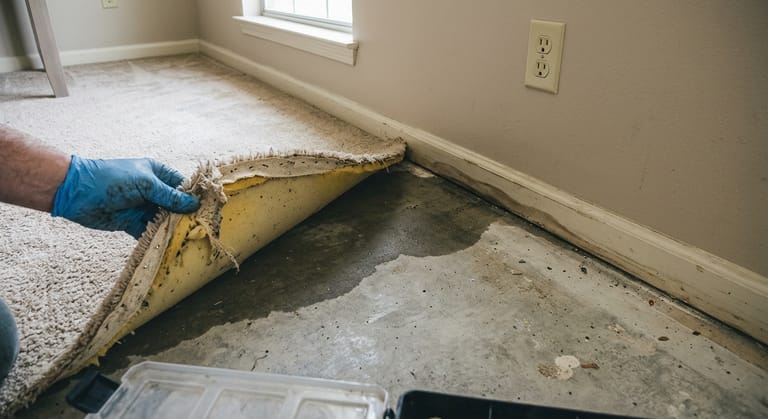
Do these before dialing
- Run the two hour meter check, every tap shut
- Photograph a warm patch, damp baseboard or lifting tile
- Note the month the bill first moved
Leave these to a license
- Pinpointing the line acoustically or with tracer gas
- Cutting, coring or drilling any part of the slab
- Judging a sleeve or backfill nobody has uncovered yet
Sun Belt slabs give way for unrelated reasons: swelling clay shearing pipe around Dallas and Fort Worth, water chemistry pitting copper from inside across Orange County, and here the trench itself, working on metal from outside. All three sit on what a slab leak is.
Still turning with every tap shut? That dial is the opening line. (800) 555-0142 rings through at any hour to an Oklahoma licensed plumber whose week is slab leak repair in OKC, and your reading starts it. No trade license sits behind this masthead: it publishes, and the plumber who takes the job carries the cost of the introduction, which your estimate never sees.